
Elements
An element is a piece of the mesh between nodes, with a section. Which kind to use depends on the shape of the member, not on the solver: a slender member is a beam, a thin wall a shell, a chunky part a solid. The meshing plugin picks the element from the geometry and the section; you choose when the geometry could take more than one.
| Element | For | Carries |
|---|---|---|
BeamElement |
slender members, length over depth above about 10 | axial force, shear, bending, torsion |
TrussElement |
pin-jointed bars | axial force only |
StrutElement, TieElement |
members that act one way: props, cables, bracing that buckles | compression only, or tension only |
ShellElement |
plates and thin walls | in-plane forces, bending, transverse shear |
MembraneElement |
fabric, very thin sheets | in-plane forces only |
CompressionOnlyMembraneElement |
plain concrete or masonry panels | in-plane compression only |
TetrahedronElement, HexahedronElement |
solids: joints, blocks, anything thick | the full 3D stress |
SpringElement, springs between nodes |
bolts, bearings, elastic supports | the stiffness you give |
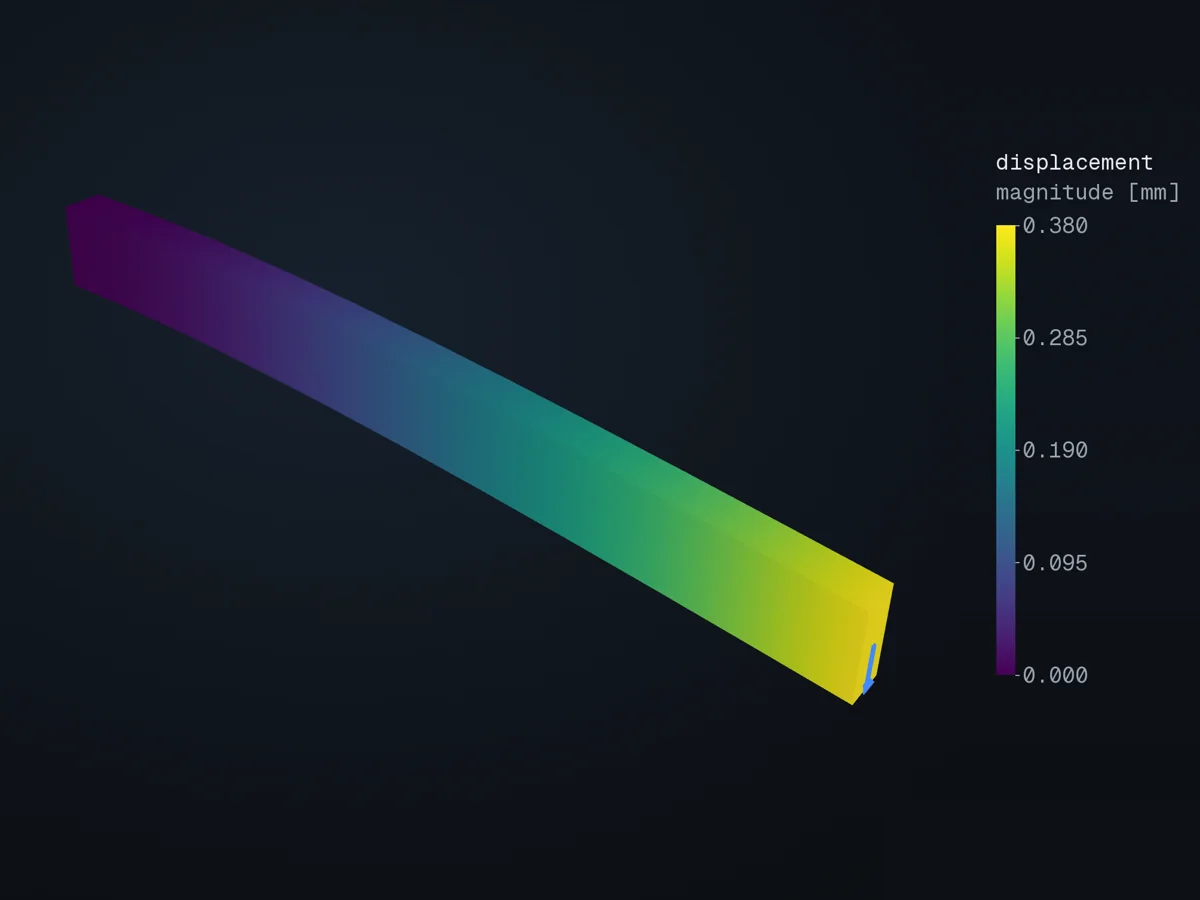
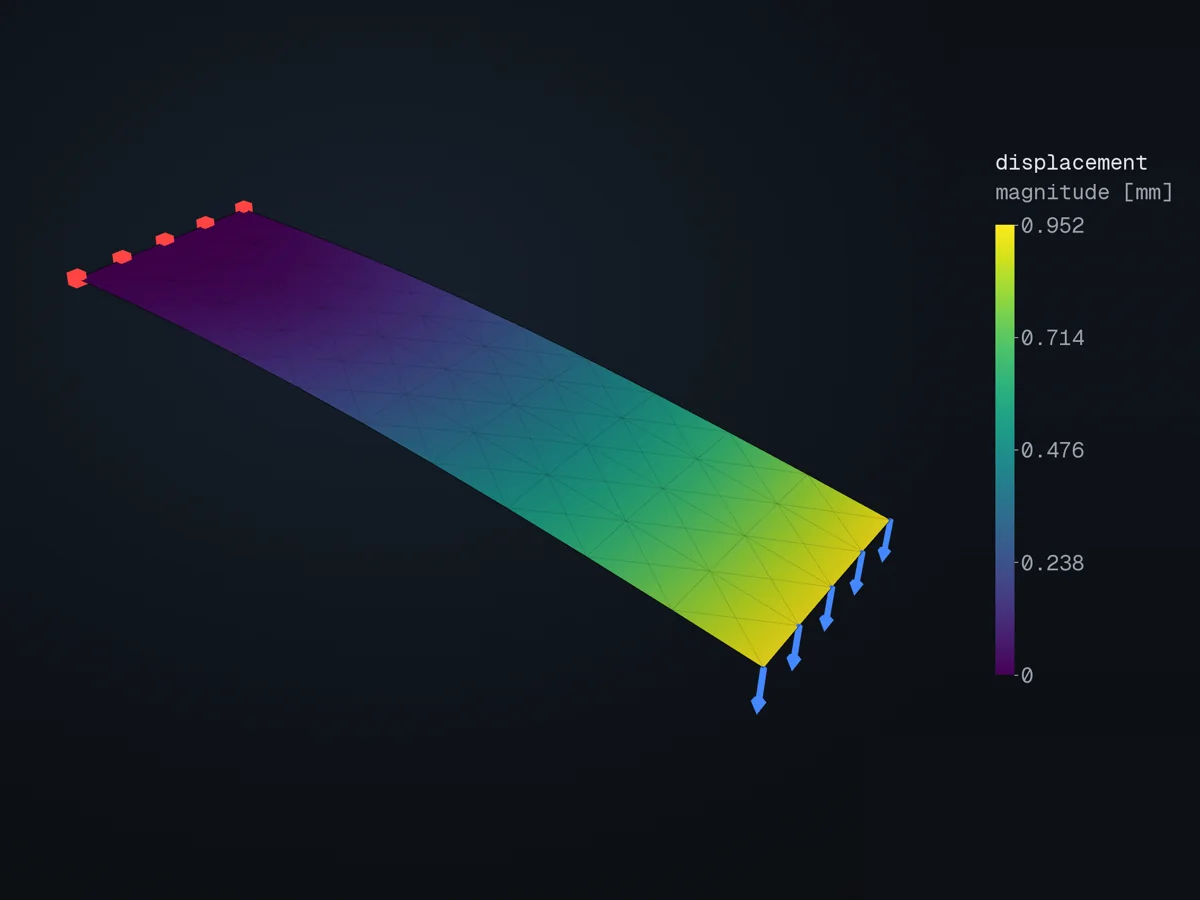
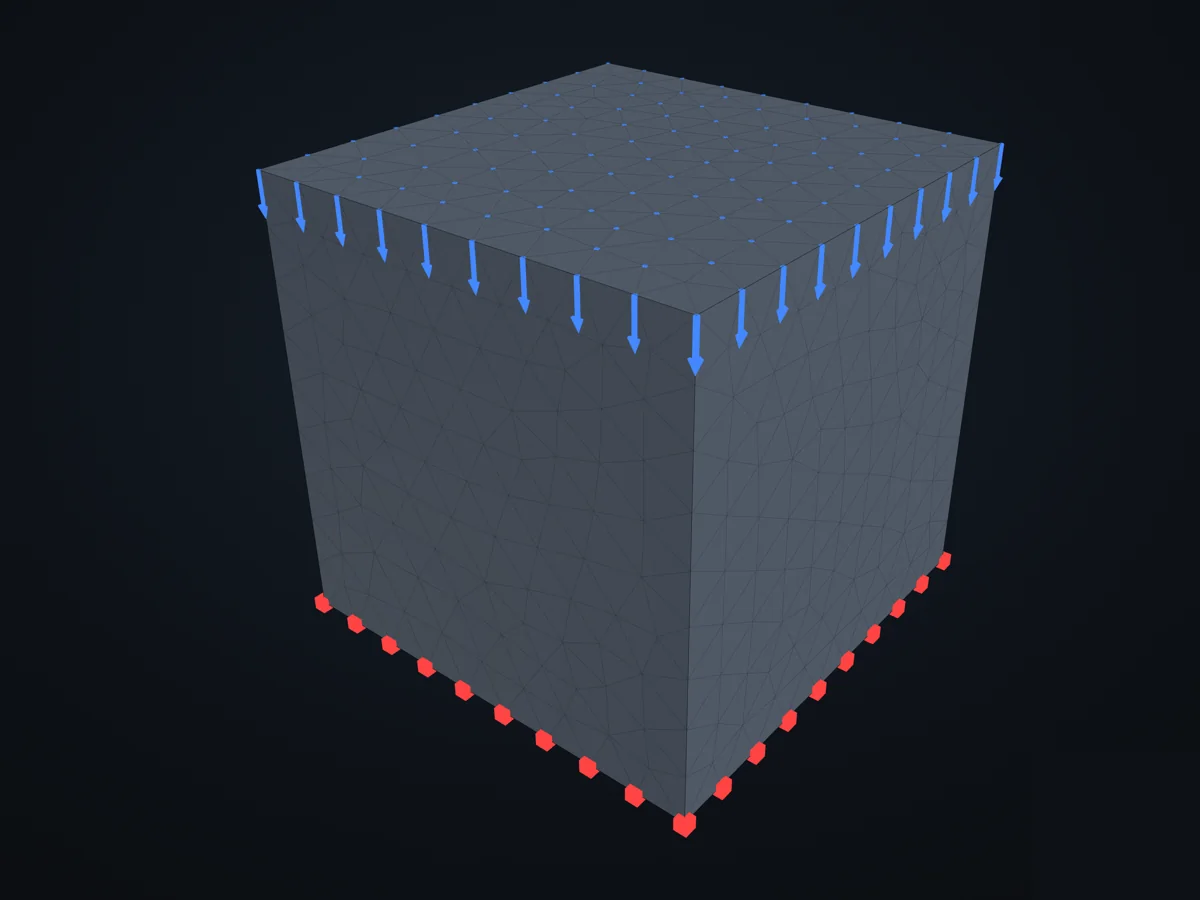
The same kind of question, three element families: a beam, a shell plate and a solid.
Choosing
Section titled “Choosing”- Use the simplest that answers the question. A frame’s member forces need beams, not solids. A joint’s stiffness or a plate’s local stresses need shells or solids.
- Beams are lines, so their section matters. The section’s profile and the beam’s
orientationdecide its stiffness: see Materials and sections. - Solids want quadratic elements. Ten-node tetrahedra (
element_order=2when meshing) are accurate; four-node ones are far too stiff in bending. Bricks through a thin plate need an incompatible-modes formulation, or several layers. - Shells sit on their mid-surface. Model a plate’s middle, and give the section its full thickness.
- One-way members make a step nonlinear. Struts, ties and one-sided springs act only in one direction, so the solver iterates to find which are active.
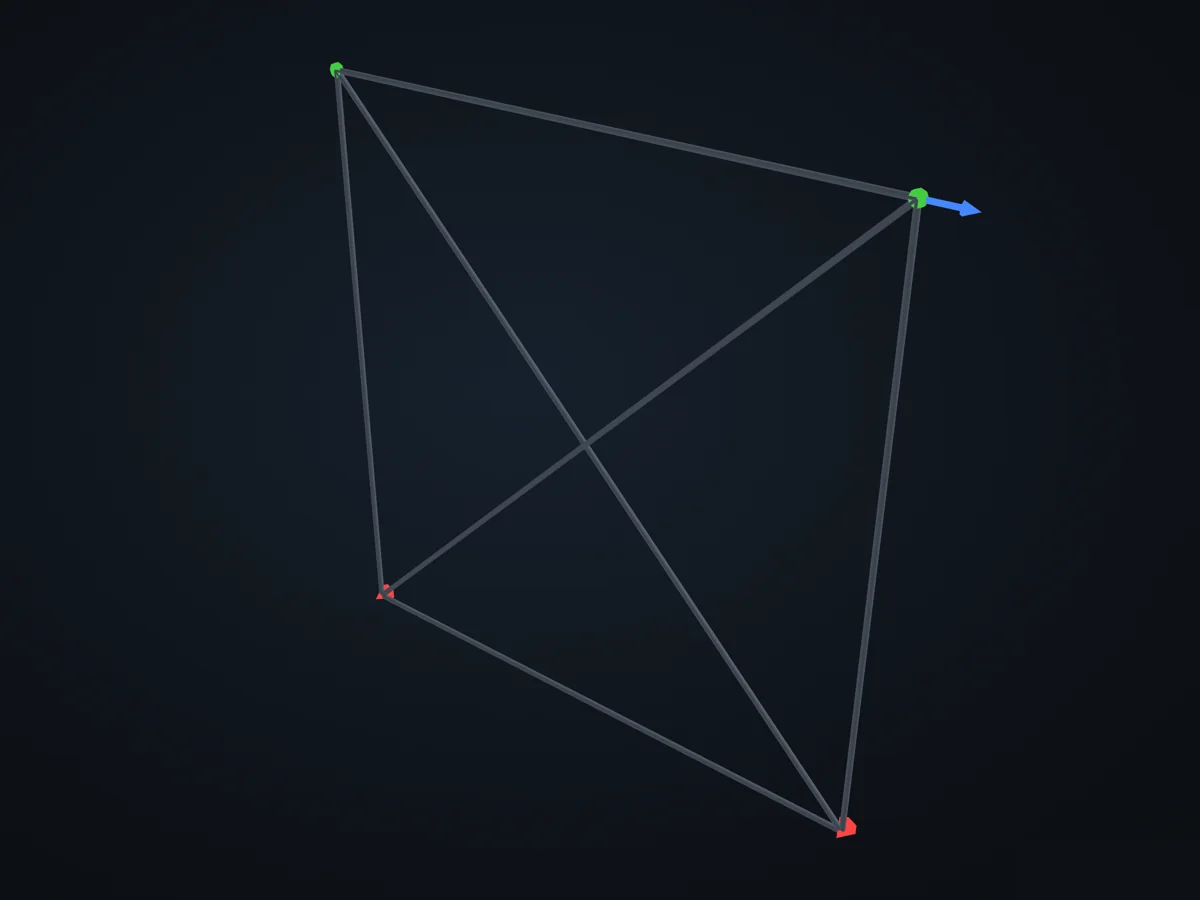
A cross-braced panel with tension-only diagonals: under a side load, one diagonal works and the other goes slack.
Mixing families
Section titled “Mixing families”A model can mix them: beams for the frame, shells for a plate, solids for a joint. Where families meet, their nodes don’t carry the same things (a solid’s node has no rotation), so join them with a coupling or a tie, not by sharing a node: see Supports, releases and joints.
In the examples
Section titled “In the examples”- A simple axial bar, a cantilever beam, a shell plate, a solid.
- The tension- and compression-only members series.
- The benchmarks: the same cantilever as beams, shells and solids, against the same formula.
The API reference lists every element and its parameters.
© 2026 Francesco Ranaudo · Text and pictures CC BY 4.0 · Code Elastic License 2.0 · how to reuse them