
Results
Results are read the same way whatever solver produced them. A step asks for result fields before the solve; after it, each field answers questions: the value at a node, the extremes, every result in a frame. The rows sit in a results database on your machine, in xfea’s own form, so a script reading results doesn’t change when the solver does.
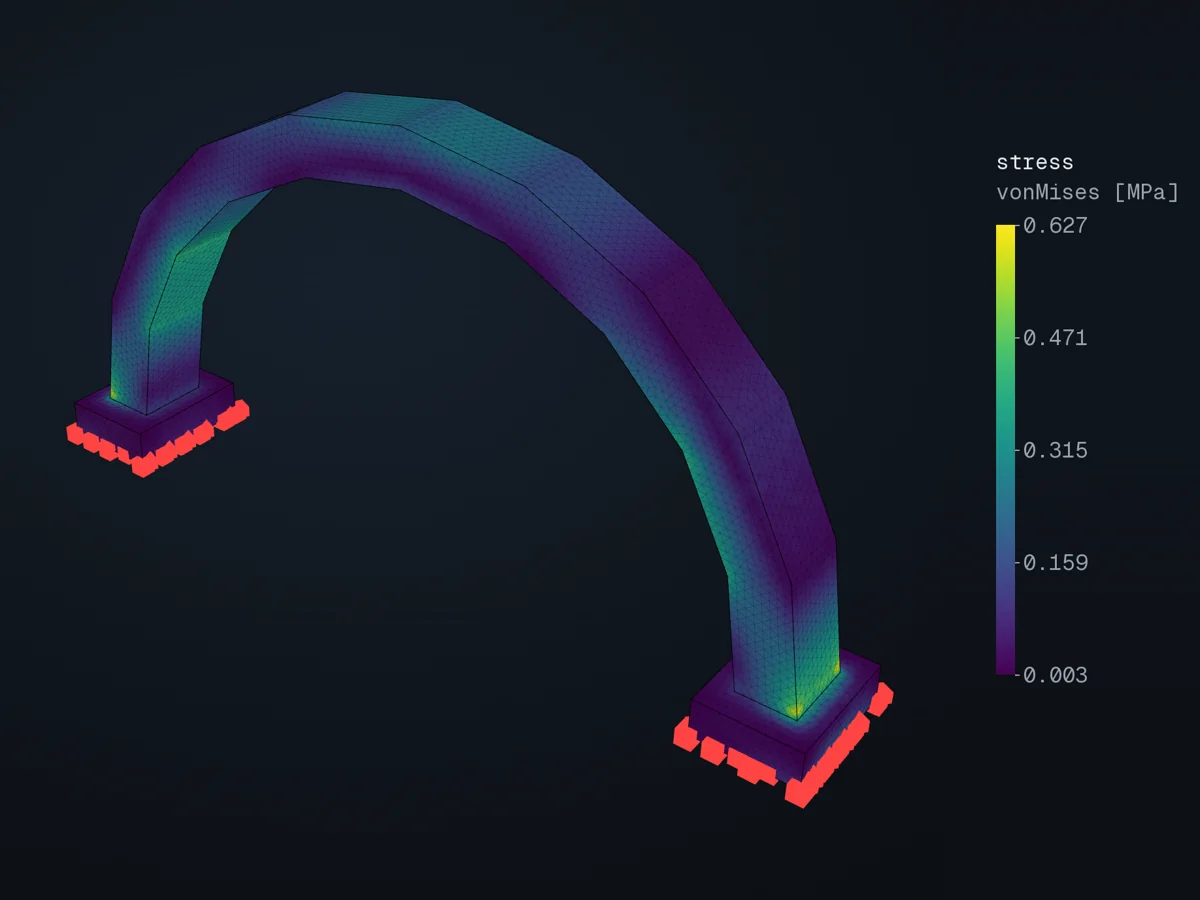
A solid arch under self-weight, coloured by von Mises stress: the peaks are where the arch meets its footings.
Ask before solving
Section titled “Ask before solving”disp = DisplacementFieldResults() # x, y, z and rotations xx, yy, zz at the nodesreact = ReactionFieldResults() # forces and moments at the supported nodesstress = StressFieldResults() # s11 ... s23 at the elements' integration pointsstep.add_field_outputs([disp, react, stress])| Field | Where | Components |
|---|---|---|
DisplacementFieldResults |
nodes | x, y, z, xx, yy, zz |
ReactionFieldResults |
supported nodes | forces x, y, z, moments xx, yy, zz |
StressFieldResults |
elements | s11 to s23, von Mises and principal stresses |
TemperatureFieldResults |
nodes | T |
ContactForcesFieldResults |
contact pairs | the total normal and tangential force on each |
ContactStressFieldResults |
contact nodes | pressure, opening, slip, shear |
A field that wasn’t asked for isn’t there to read: ask for what answers the question.
Read after solving
Section titled “Read after solving”tip = disp.get_result_at(tip_node).z # one nodesag = disp.get_min_result("z").z # the most negative z: downward deflectionpeak = max(r.von_mises_stress for r in stress.results)total = sum(r.z for r in react.results) # the reactions add up to the loadsEvery read is at the end of the step unless a frame is asked: a nonlinear step keeps one frame per increment
(disp.frames_in_step()). Modal and buckling steps give their frequencies and factors, and each mode’s shape.
Read with judgement
Section titled “Read with judgement”- Reactions are the first check. They must add up to the loads: if they don’t, a load or a support isn’t where you think.
- A stress peak at a corner is a singularity, not a result: it grows as the mesh is refined. Refine twice and compare; read stresses a little away from corners, supports and point loads.
- Von Mises for ductile metals, principal stresses for brittle ones.
Keep the answer with the run
Section titled “Keep the answer with the run”problem.record_result("tip deflection", tip, "mm", note="L/250 = 8 mm")The numbers that answer the question go into the solve’s run record and its one-page report, next to the convergence, the model’s make-up and the warnings: one page to open or send. See Checking a model.
Seeing them
Section titled “Seeing them”The result as a picture, the deformed shape coloured by any field, comes from show_results (your AI assistant
draws it), and the results in 3D from the viewer, in your browser. See Viewers, and
open any example in 3D.
In the examples
Section titled “In the examples”- Querying results.
- Inspect results and prepare a viewer scene.
- The benchmarks: each result checked against a formula.
Results goes through reading them in detail; the API reference has every field and method. How results are stored is in Results schema and readers.
© 2026 Francesco Ranaudo · Text and pictures CC BY 4.0 · Code Elastic License 2.0 · how to reuse them