
Cantilever beam — Thermal analysis — 3D Solid elements
Steady-state heat conduction through a cantilever beam modelled as a solid box (L x b x h). Fixed temperatures at both ends: T_hot = 373.15 K (100 C) at x = 0 T_cold = 293.15 K (20 C) at x = L
Analytical (1D steady-state conduction): T(x) = T_hot + (T_cold - T_hot) * x / L
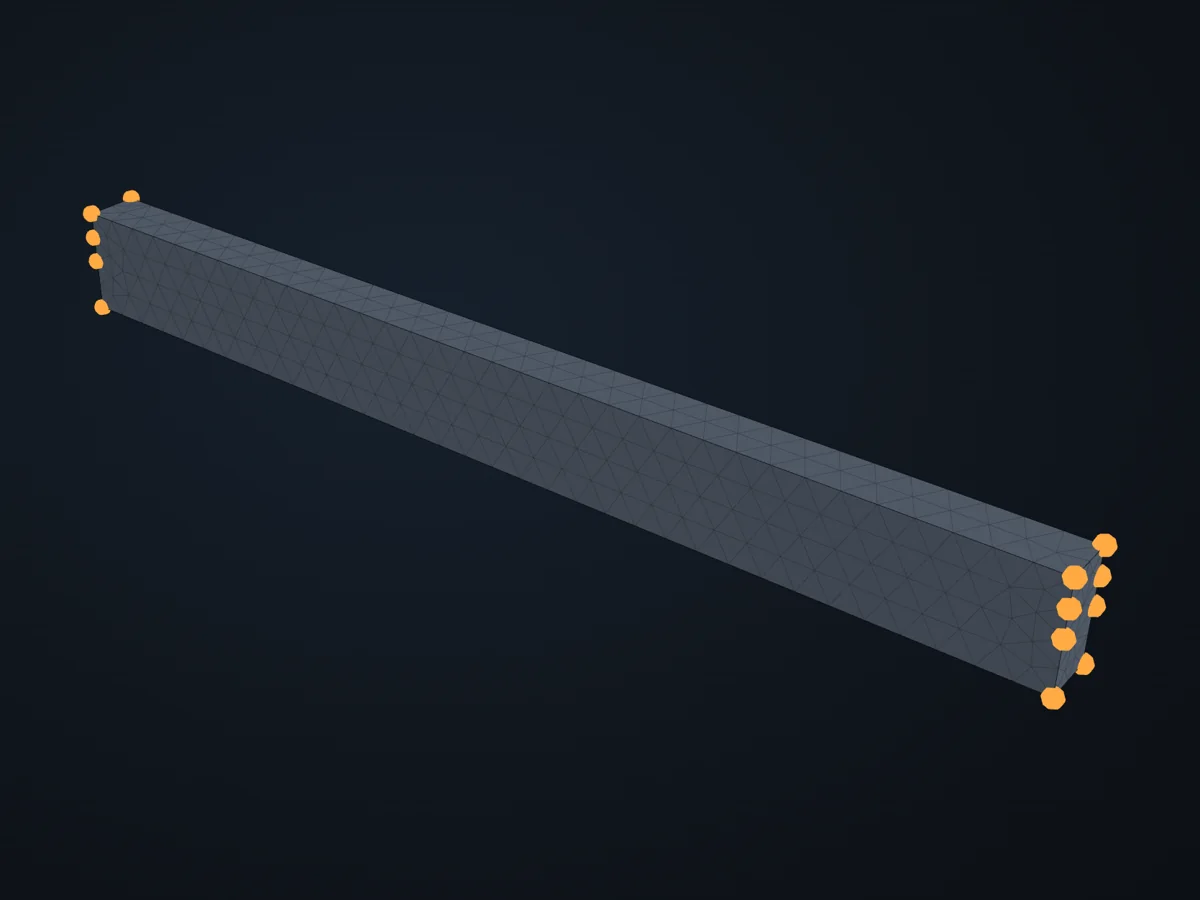
The model before it is solved: its parts, supports (red) and loads (blue).
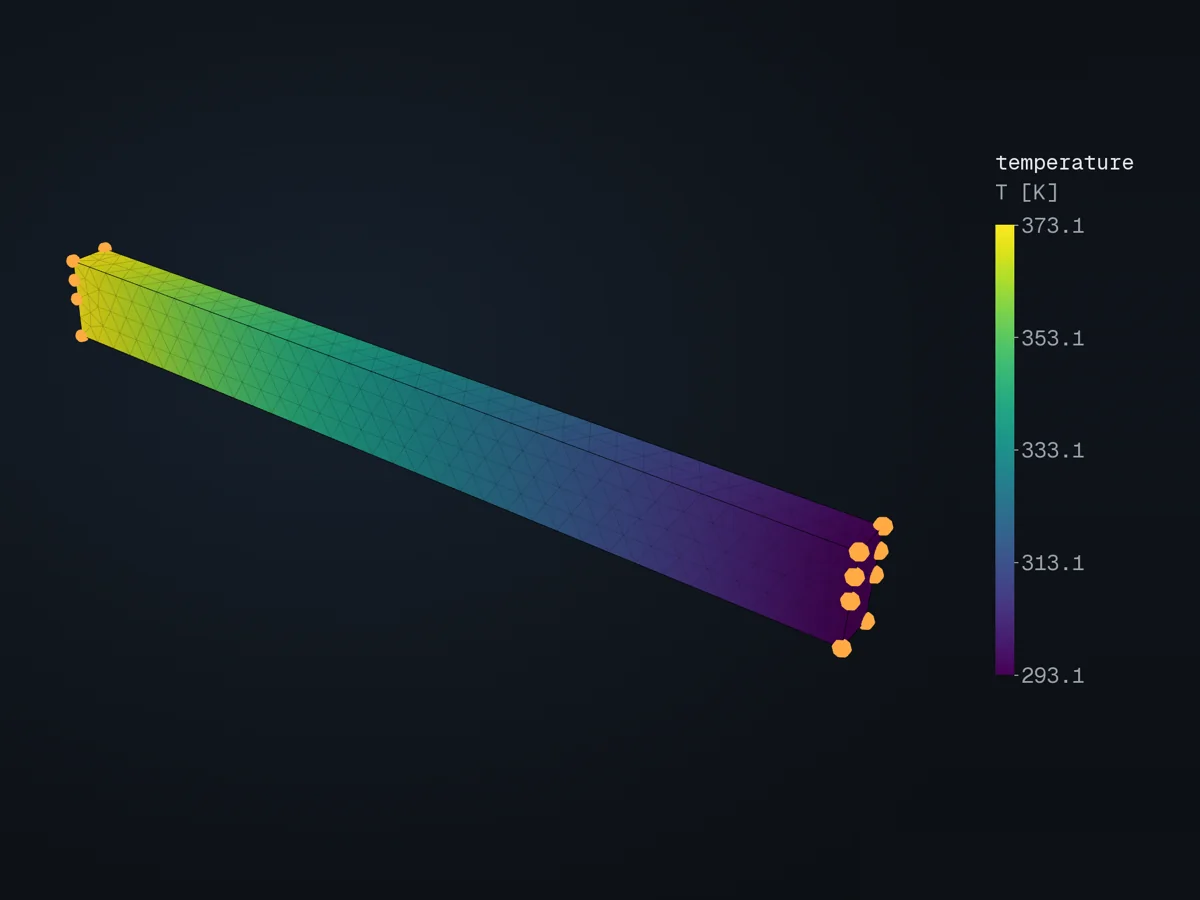
The model, coloured by temperature (T [K]), in xfea’s 3D viewer.
Open in 3D turn it, cut it, pick any field: in xfea's viewer, in your browser
Verification
Section titled “Verification”In the latest verification run, on 2026-11-21, through the conversion service as users solve, 3 of 3 checks pass.
| Quantity / reference from | xfea | Reference | Deviation | Tolerance | |
|---|---|---|---|---|---|
| Min temperature (x=L) [K] analytical | 293.15 | 293.15 | 0.00 % | 1 % | |
| Max temperature (x=0) [K] analytical | 373.15 | 373.15 | 0.00 % | 1 % | |
| Mid-span temperature [K] analytical | 333.15 | 333.15 | 0.00 % | 1 % |
The script
Section titled “The script”examples/scripts/04_reference_cases/benchmarks/cantilever_thermal_3d.py. Run it from the repository with uv run python examples/scripts/04_reference_cases/benchmarks/cantilever_thermal_3d.py, or, with xfea-examples installed, xfea-examples run 04_reference_cases/benchmarks/cantilever_thermal_3d.py.
from xfea.meshing import MeshingSettingsfrom xfea.model import Model, Part, SolidSectionfrom xfea.problem import HeatTransferStep, Problemfrom xfea.results import TemperatureFieldResults
from _bench_utils import (    CANTILEVER_LENGTH,    BEAM_WIDTH,    BEAM_HEIGHT,    T_COLD,    T_HOT,    _ensure_box_step,    compare,    out_dir,    thermal_material,)from xfea_examples.models import _nodes_at_extreme
# ── Model ─────────────────────────────────────────────────────────────────L = CANTILEVER_LENGTHb = BEAM_WIDTHh = BEAM_HEIGHT
step_path = _ensure_box_step("beam_cantilever_3d.stp", L, b, h)
mat = thermal_material()sec = SolidSection(material=mat)
model = Model(name="bench_cantilever_thermal_3d")with model:    part = model.add_part(Part(name="solid"))    part.base_geometry = step_path    part.mesh(settings=MeshingSettings(min=15, max=30), section=sec)
hot_nodes = _nodes_at_extreme(part.nodes, axis="x", mode="min")cold_nodes = _nodes_at_extreme(part.nodes, axis="x", mode="max")
model.add_uniform_thermal_ics_field(T0=T_COLD, nodes=part.nodes)model.add_thermal_bc(nodes=hot_nodes, temperature=T_HOT)model.add_thermal_bc(nodes=cold_nodes, temperature=T_COLD)
# ── Problem ───────────────────────────────────────────────────────────────problem = model.add_problem(Problem(name="cantilever_thermal_3d"))step = problem.add_step(    HeatTransferStep(        name="steady_state",        steady_state=True,    ))
temp = TemperatureFieldResults()step.add_field_outputs([temp])
problem.analyse_and_extract(path=out_dir(model.name), verbose=True)
# ── Comparison ────────────────────────────────────────────────────────────print()print("=" * 65)print("Cantilever Beam — Thermal (Steady-State) — 3D Solid Elements")print("=" * 65)print()
min_temp = temp.get_min_result("T")max_temp = temp.get_max_result("T")
fea_min_K = float(min_temp.T)fea_max_K = float(max_temp.T)
compare("Min temperature (x=L) [K]", fea_min_K, T_COLD, tol_pct=1.0)compare("Max temperature (x=0) [K]", fea_max_K, T_HOT, tol_pct=1.0)
# Mid-span temperature checkT_mid_ref = (T_HOT + T_COLD) / 2.0mid_x = L / 2.0mid_temps = []for r in temp.results: if abs(r.node.x - mid_x) < 5.0: val = float(r.T) mid_temps.append(val)if mid_temps: fea_mid_K = sum(mid_temps) / len(mid_temps) compare("Mid-span temperature [K]", fea_mid_K, T_mid_ref, tol_pct=1.0)else: print(f" Expected mid-span temperature: {T_mid_ref:.2f} K ({T_mid_ref - 273.15:.1f} C)") print(" (No nodes found near mid-span to verify)")© 2026 Francesco Ranaudo · Text and pictures CC BY 4.0 · Code Elastic License 2.0 · how to reuse them