
Planar 5×7-bay grid with mixed unilateral and bilateral members
Part 4 of the unilateral-elements series.
Geometry
Section titled “Geometry”A rectangular grid in the XY plane, 55 m × 42 m:
- 5 bays along X × 7 bays along Y → (nx+1)·(ny+1) = 6×8 = 48 nodes- each bay is 11 m × 6 mEvery bay is framed like this:
n_ij ────── tie along X ─────── n_(i+1)j │ \ / │ │ \ diag A / │ struts (diag A and B) are │ \ / │ compression-only (StrutElement) │ Y-truss \ / │ the Y-edges are bilateral │ (bilateral) \ / │ TrussElements; the X-edges │ \ / │ are tension-only TieElements │ \/ │ │ /\ │ │ / \ │ │ / \ │ │ / \ │ │ / diag B \ │ │ / \ │ │ / \ │n_i(j+1) ─── tie along X ───── n_(i+1)(j+1)Boundary conditions
Section titled “Boundary conditions”The four global-corner nodes are pinned. Every other node is
rollerXY (free in x and y, clamped in z only) so the grid stays
planar but can deform in-plane.
A −Y force (into the top edge, toward the grid centre) is applied to every node on the top edge that isn’t a corner — four nodes total.
Results
Section titled “Results”The axial force of every member is computed from the nodal displacements and its unilateral law. A matplotlib figure of the plan view is saved next to the solver output and shown interactively. Each element is colour-coded — blue = compression, red = tension, light gray = slack — and the line width scales with |N|. Pinned corners and load arrows are annotated.
Units: mm / N / MPa.
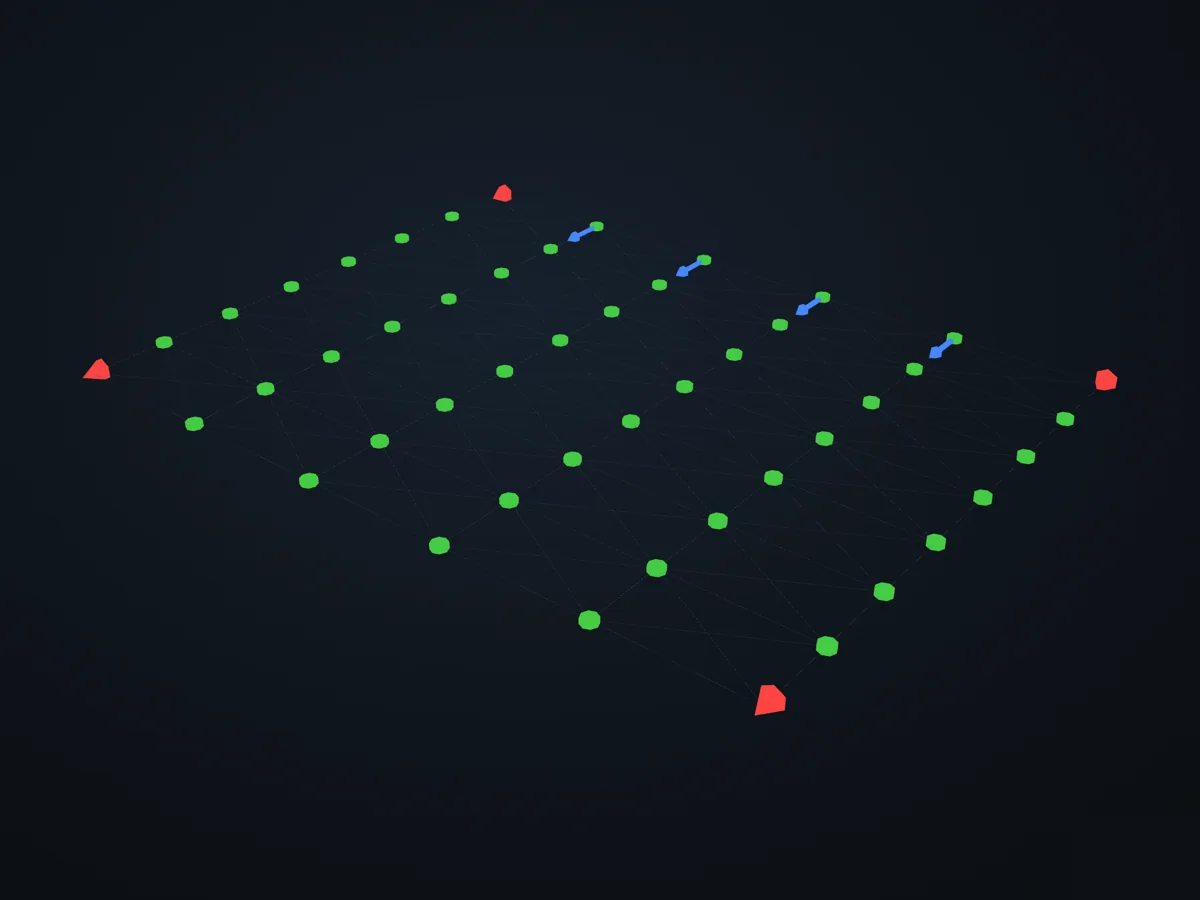
The model before it is solved: its parts, supports (red) and loads (blue).
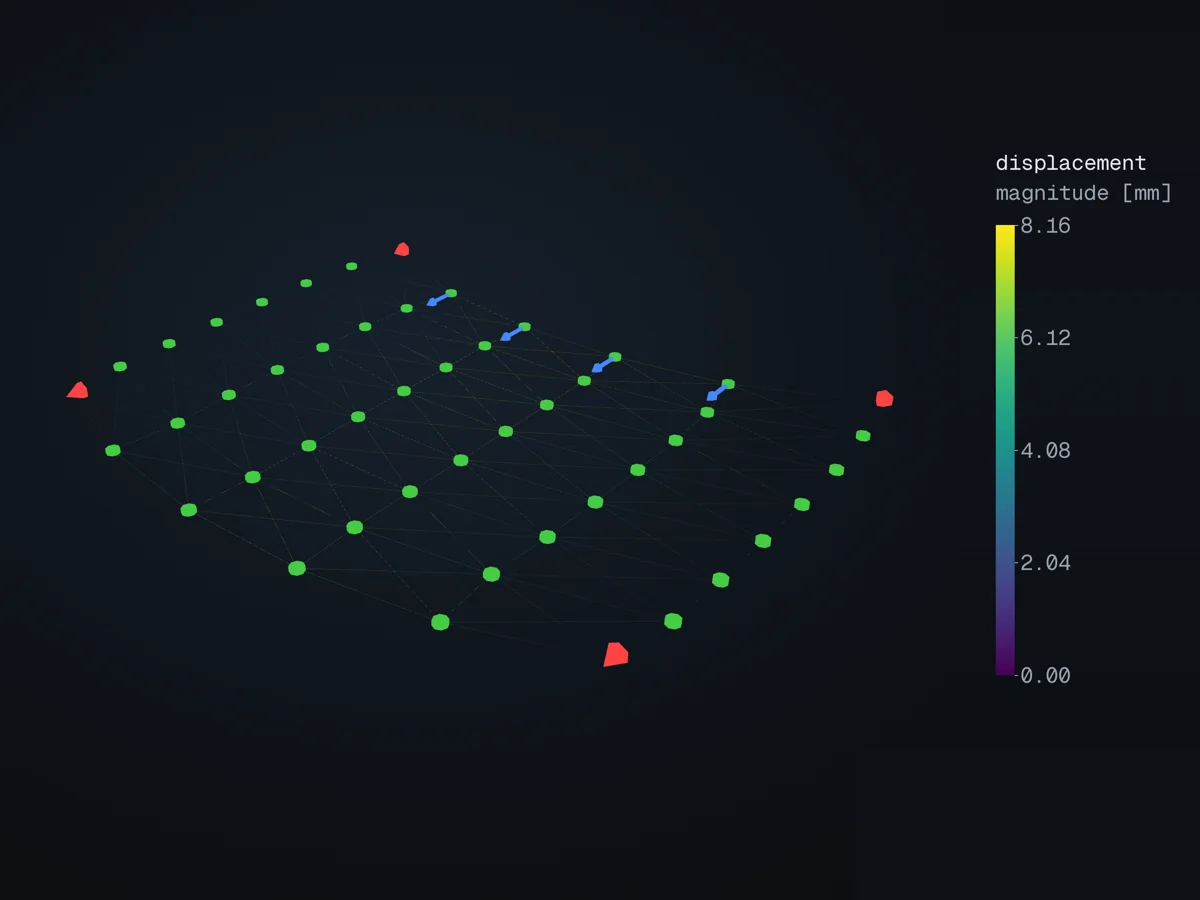
The deformed shape, coloured by displacement (magnitude [mm]), in xfea’s 3D viewer.
Open in 3D turn it, cut it, pick any field: in xfea's viewer, in your browser
The script
Section titled “The script”examples/scripts/02_core_concepts/unilateral_elements/04_grid_mixed_members.py. Run it from the repository with uv run python examples/scripts/02_core_concepts/unilateral_elements/04_grid_mixed_members.py, or, with xfea-examples installed, xfea-examples run 02_core_concepts/unilateral_elements/04_grid_mixed_members.py.
from __future__ import annotations
import mathfrom pathlib import Path
from xfea.model import (    ElasticIsotropic,    Model,    Node,    Part,    StrutElement,    StrutSection,    TieElement,    TieSection,    TrussElement,    TrussSection,)from xfea.problem import Problem, StaticStepfrom xfea.results import DisplacementFieldResults
from xfea_examples import out_dir

# Geometry / material / loadNX, NY = 5, 7                 # bays along X and YLX_BAY = 11_000.0             # [mm]LY_BAY = 6_000.0              # [mm]
A_TIE_X = 200.0               # [mm²] slender rod along X (tension only)A_TRUSS_Y = 500.0             # [mm²] bilateral column member along YA_STRUT_DIAG = 300.0          # [mm²] compression-only diagonal brace
P_LOAD = -10_000.0            # [N] force per top-edge (non-corner) node in Y                              #     negative = pulling the top edge inward
steel = ElasticIsotropic(E=210_000.0, v=0.3, density=7.85e-9, name="steel")

# Model builderdef build_grid() -> tuple[Model, list[list[Node]], list[Node]]:    model = Model(name="grid_mixed_members", description="5×7 bay grid")    part = model.add_part(Part(name="grid"))
    tie_x = TieSection(A=A_TIE_X, material=steel)    truss_y = TrussSection(A=A_TRUSS_Y, material=steel)    strut_diag = StrutSection(A=A_STRUT_DIAG, material=steel)
    nodes: list[list[Node]] = [[None] * (NY + 1) for _ in range(NX + 1)]    for i in range(NX + 1):        for j in range(NY + 1):            nodes[i][j] = part.add_node(                Node(xyz=[i * LX_BAY, j * LY_BAY, 0.0])            )
    # --- TieElement along X: every row, consecutive i, i+1 ---    for j in range(NY + 1):        for i in range(NX):            part.add_element(                TieElement(nodes=[nodes[i][j], nodes[i + 1][j]], section=tie_x)            )    # --- TrussElement along Y: every column, consecutive j, j+1 ---    for i in range(NX + 1):        for j in range(NY):            part.add_element(                TrussElement(nodes=[nodes[i][j], nodes[i][j + 1]], section=truss_y)            )    # --- StrutElement X-bracing: two diagonals per bay ---    for i in range(NX):        for j in range(NY):            part.add_element(  # diag A: (i,j) → (i+1, j+1)                StrutElement(                    nodes=[nodes[i][j], nodes[i + 1][j + 1]],                    section=strut_diag,                )            )            part.add_element(  # diag B: (i+1,j) → (i, j+1)                StrutElement(                    nodes=[nodes[i + 1][j], nodes[i][j + 1]],                    section=strut_diag,                )            )
    corners = [nodes[0][0], nodes[NX][0], nodes[0][NY], nodes[NX][NY]]    model.add_pin_bc(nodes=corners)    others = [        nodes[i][j]        for i in range(NX + 1)        for j in range(NY + 1)        if nodes[i][j] not in corners    ]    model.add_rollerXY_bc(nodes=others)  # free in x, y; clamp z only
    top_edge_loaded = [nodes[i][NY] for i in range(1, NX)]    return model, nodes, top_edge_loaded

# Axial force helpers (reconstruct N from nodal displacements)def _axis(n1: Node, n2: Node) -> tuple[float, float, float]:    dx = float(n2.x) - float(n1.x)    dy = float(n2.y) - float(n1.y)    dz = float(n2.z) - float(n1.z)    mag = math.sqrt(dx * dx + dy * dy + dz * dz)    return (dx / mag, dy / mag, dz / mag)

def _elongation(element, disp_field, time) -> float:    n1, n2 = element.nodes    u1 = disp_field.get_result_at(n1, time=time)    u2 = disp_field.get_result_at(n2, time=time)    du = (        float(u2.x) - float(u1.x),        float(u2.y) - float(u1.y),        float(u2.z) - float(u1.z),    )    ax, ay, az = _axis(n1, n2)    return du[0] * ax + du[1] * ay + du[2] * az

def _axial_mode(element) -> str:    """Decide which unilateral branch to apply when reconstructing N."""    if isinstance(element, StrutElement):        return "strut"    if isinstance(element, TieElement):        return "tie"    return "bilateral"

def _axial_force(element, disp_field, time) -> float:    L_el = float(element.length)    if L_el <= 0.0:        return 0.0    K = float(element.section.material.E) * float(element.section.A) / L_el    try:        delta = _elongation(element, disp_field, time)    except (TypeError, AttributeError):        return 0.0    if not math.isfinite(delta):        return 0.0    mode = _axial_mode(element)    if mode == "tie":        return K * delta if delta > 0 else 0.0    if mode == "strut":        return K * delta if delta < 0 else 0.0    return K * delta

# Matplotlib view of the axial-force distributiondef plot_axial_forces(    elements,    axial: dict,    corner_nodes,    loaded_nodes,    save_to=None,    show: bool = True,    slack_threshold: float = 1.0,    min_lw: float = 0.6,    max_lw: float = 4.0,):    """Draw the grid in plan view (XY) with one coloured line per element.
    Colours    -------    - tab:red    — tension (N > slack_threshold)    - tab:blue   — compression (N < -slack_threshold)    - lightgray  — |N| ≤ slack_threshold (the member is slack)
    Line width encodes |N| linearly between ``min_lw`` and ``max_lw``.    Pinned corners are drawn as black squares; loaded nodes are annotated    with a load arrow.    """    import matplotlib.lines as mlines    import matplotlib.pyplot as plt
    fig, ax = plt.subplots(figsize=(12, 9))
    max_abs_N = max((abs(N) for N in axial.values()), default=1.0) or 1.0
    # Sort elements by |N| so the most-loaded members are drawn last    # (and therefore on top of any crossing slack diagonals).    labels = []   # deferred until after the lines are drawn    for el in sorted(elements, key=lambda e: abs(axial.get(e, 0.0))):        N = axial.get(el, 0.0)        n1, n2 = el.nodes        x0, y0 = float(n1.x), float(n1.y)        x1, y1 = float(n2.x), float(n2.y)        if abs(N) <= slack_threshold:            color = "lightgray"            lw = min_lw            z = 1        elif N < 0.0:            color = "tab:blue"            lw = min_lw + (max_lw - min_lw) * (abs(N) / max_abs_N)            z = 2        else:            color = "tab:red"            lw = min_lw + (max_lw - min_lw) * (abs(N) / max_abs_N)            z = 2        ax.plot([x0, x1], [y0, y1], color=color, linewidth=lw,                solid_capstyle="round", zorder=z)
        if abs(N) > slack_threshold:            # Put the axial-force label at the element midpoint,            # rotated to sit along the member so the text flows with            # the element's direction.  Kilonewtons are the natural            # unit here (everything is in the 10²–10⁴ N range).            mx = 0.5 * (x0 + x1)            my = 0.5 * (y0 + y1)            angle = math.degrees(math.atan2(y1 - y0, x1 - x0))            # Keep the text upright (no upside-down labels).            if angle > 90:                angle -= 180            if angle < -90:                angle += 180            labels.append((mx, my, N, color, angle))
    for mx, my, N, color, angle in labels:        text = f"{N / 1000:+.2f} kN"        ax.text(            mx, my, text,            rotation=angle, rotation_mode="anchor",            ha="center", va="center",            fontsize=6, color=color, fontweight="semibold",            bbox=dict(                facecolor="white", edgecolor="none",                alpha=0.85, pad=0.5, boxstyle="round,pad=0.2",            ),            zorder=10,        )
    # Nodes    all_nodes = {n for el in elements for n in el.nodes}    ax.scatter(        [float(n.x) for n in all_nodes],        [float(n.y) for n in all_nodes],        s=14,        color="black",        zorder=5,    )
    # Pinned corner markers    ax.scatter(        [float(n.x) for n in corner_nodes],        [float(n.y) for n in corner_nodes],        s=120,        facecolor="black",        marker="s",        zorder=6,        label="pinned corner",    )
    # Load arrows at the loaded nodes (fixed visual length so they're    # legible relative to the bay size regardless of the actual force    # magnitude).    if loaded_nodes:        arrow_len = 0.6 * LY_BAY  # mm        dy = -arrow_len if P_LOAD < 0 else +arrow_len        for n in loaded_nodes:            ax.annotate(                "",                xy=(float(n.x), float(n.y) + dy),                xytext=(float(n.x), float(n.y)),                arrowprops=dict(arrowstyle="-|>", color="black", lw=1.8,                                shrinkA=0, shrinkB=0),                zorder=7,            )
    # Legend    compr = mlines.Line2D([], [], color="tab:blue", lw=3, label="compression")    tens = mlines.Line2D([], [], color="tab:red", lw=3, label="tension")    slack = mlines.Line2D([], [], color="lightgray", lw=1.2, label="slack")    pin = mlines.Line2D([], [], color="black", marker="s", linestyle="None",                        markersize=9, label="pinned corner")    ax.legend(handles=[compr, tens, slack, pin], loc="upper right",              framealpha=0.9)
    # Style    ax.set_aspect("equal")    ax.set_xlabel("X (mm)")    ax.set_ylabel("Y (mm)")    ax.set_title(        f"Grid axial forces (step end)\n"        f"P_load = {P_LOAD:+.0f} N/node on top edge  |  "        f"max |N| = {max_abs_N:,.0f} N"    )    ax.grid(True, alpha=0.25, linestyle=":")
    # Pad the axis a bit so arrow tips aren't clipped.    ax.margins(0.05)
    fig.tight_layout()    if save_to is not None:        fig.savefig(save_to, dpi=150)        print(f"  axial-force plot saved: {save_to}")    if show:        print("  (close the matplotlib window to finish)")        plt.show()    else:        plt.close(fig)

# Maindef _classify(element) -> str:    if isinstance(element, StrutElement):        return "strut"    if isinstance(element, TieElement):        return "tie"    return "truss"

def main() -> None:    model, grid, loaded_nodes = build_grid()    elements = list(model.parts[0].elements)
    counts = {"truss": 0, "tie": 0, "strut": 0}    for el in elements:        counts[_classify(el)] += 1    print(f"Grid built: {(NX + 1) * (NY + 1)} nodes, {len(elements)} elements")    print(f"  TieElement   (X, tension-only)       : {counts['tie']}")    print(f"  TrussElement (Y, bilateral)          : {counts['truss']}")    print(f"  StrutElement (diag, compression-only): {counts['strut']}")    print(f"Loaded nodes (top edge, Y = {P_LOAD:+.0f} N each) : {len(loaded_nodes)}")    print()
    problem = model.add_problem(Problem(name="grid_run"))    step = problem.add_step(        StaticStep(            name="pull_top",            nlgeom=True,            initial_inc_size=0.25,            max_inc_size=1.0,            min_inc_size=1e-4,            max_increments=80,        )    )    step.add_uniform_forcefield(        nodes=loaded_nodes, y=P_LOAD, load_case="pull_top"    )
    disp = DisplacementFieldResults()    step.add_field_outputs([disp])
    out = Path(out_dir(model.name))    problem.analyse_and_extract(path=out, verbose=True)
    # Reconstruct per-element axial force from nodal displacements.    STEP_END = 1.0    axial: dict = {el: _axial_force(el, disp, STEP_END) for el in elements}
    print()    print("=" * 70)    print("Results at step end (t = 1.0):")    max_uy = disp.get_max_result("y")    min_uy = disp.get_min_result("y")    print(f"  max u_y = {float(max_uy.y):+.3f} mm   (node {max_uy.location.key})")    print(f"  min u_y = {float(min_uy.y):+.3f} mm   (node {min_uy.location.key})")
    # Summary of axial forces per element family.    print()    print("Axial force summary (sign: + tension, − compression):")    for kind in ("truss", "tie", "strut"):        forces = [N for el, N in axial.items() if _classify(el) == kind]        if not forces:            continue        peak_t = max(forces)        peak_c = min(forces)        slack = sum(1 for N in forces if abs(N) < 1.0)        print(            f"  {kind:<6} ({len(forces):>3} elements) : "            f"N_max = {peak_t:+9.1f} N, N_min = {peak_c:+9.1f} N, "            f"slack ≈ {slack}"        )
    # Top-5 tensed and top-5 compressed members for a quick engineering feel.    sorted_by_N = sorted(axial.items(), key=lambda kv: kv[1])    print()    print("Top 5 most-compressed members:")    for el, N in sorted_by_N[:5]:        n1, n2 = el.nodes        print(            f"  {_classify(el):<6} elem {el.key:>3} : "            f"N = {N:+9.1f} N   "            f"({float(n1.x) / 1000:.1f},{float(n1.y) / 1000:.1f} → "            f"{float(n2.x) / 1000:.1f},{float(n2.y) / 1000:.1f}) m"        )    print("Top 5 most-tensioned members:")    for el, N in sorted_by_N[-5:][::-1]:        n1, n2 = el.nodes        print(            f"  {_classify(el):<6} elem {el.key:>3} : "            f"N = {N:+9.1f} N   "            f"({float(n1.x) / 1000:.1f},{float(n1.y) / 1000:.1f} → "            f"{float(n2.x) / 1000:.1f},{float(n2.y) / 1000:.1f}) m"        )    print("=" * 70)
    # Matplotlib plot: each element drawn in blue (compression),    # red (tension), or light gray (slack), line width scaled by |N|.    png_path = out / "axial_forces.png"    try:        plot_axial_forces(            elements,            axial,            corner_nodes=[grid[0][0], grid[NX][0], grid[0][NY], grid[NX][NY]],            loaded_nodes=loaded_nodes,            save_to=png_path,            show=True,        )    except Exception as exc:  # pragma: no cover — matplotlib optional        print(f"  plot skipped ({type(exc).__name__}: {exc})")

if __name__ == "__main__": main()© 2026 Francesco Ranaudo · Text and pictures CC BY 4.0 · Code Elastic License 2.0 · how to reuse them