
Cross-braced shear panel — mixed TrussElement + TieElement diagonals
Part 3 of the unilateral-elements series.
A one-bay braced frame in the xz plane:
n_tl ────── top chord ────── n_tr     ← lateral load applied here │ \                      / │ │  \                    /  │ │   \  diag B   diag A/   │         columns are regular TrussElements │    \                /    │         both diagonals are TieElements │     \              /     │         (so each can only pull) │      \            /      │ │       \          /       │ │        \        /        │ │         \      /         │ │          \    /          │ │           \  /           │ │            \/            │ │            /\            │ │           /  \           │ │          /    \          │ │         /      \         │ │        /        \        │ │       /          \       │ │      /            \      │ n_bl ─── bottom chord ────── n_br    (both pinned)
diag A = bl → trdiag B = br → tl
Applying a horizontal load at n_tr stretches diag A (it’s the diagonal
oriented from bottom-left to top-right of the shear direction) while
diag B would want to shorten — since both diagonals are TieElement
with zero stiffness in compression, diag B goes slack and diag A alone
carries the shear, like a cable-braced steel panel. Flipping the load
sign swaps the roles.
Both load cases are solved and the axial force in each diagonal is reconstructed from the nodal displacements.
Units: mm / N / MPa.
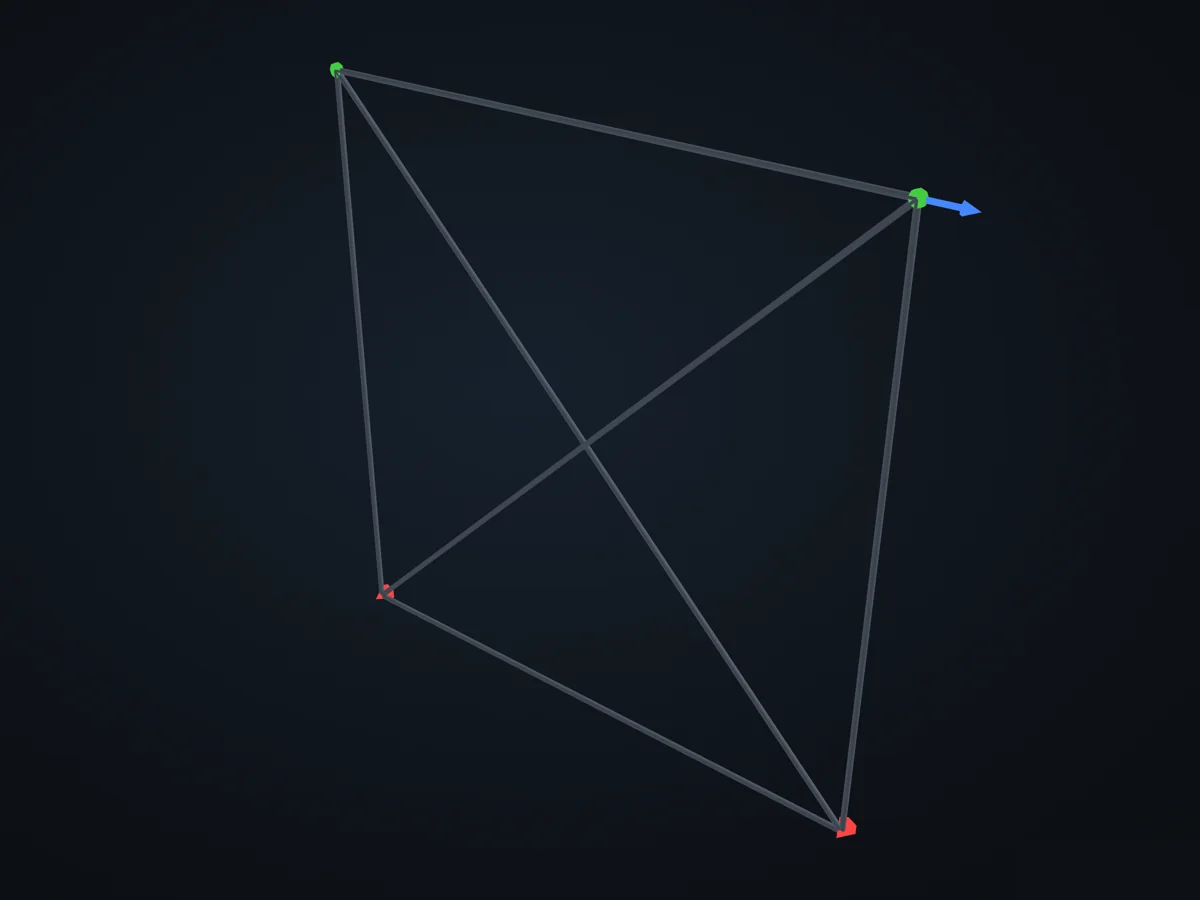
The model before it is solved: its parts, supports (red) and loads (blue).
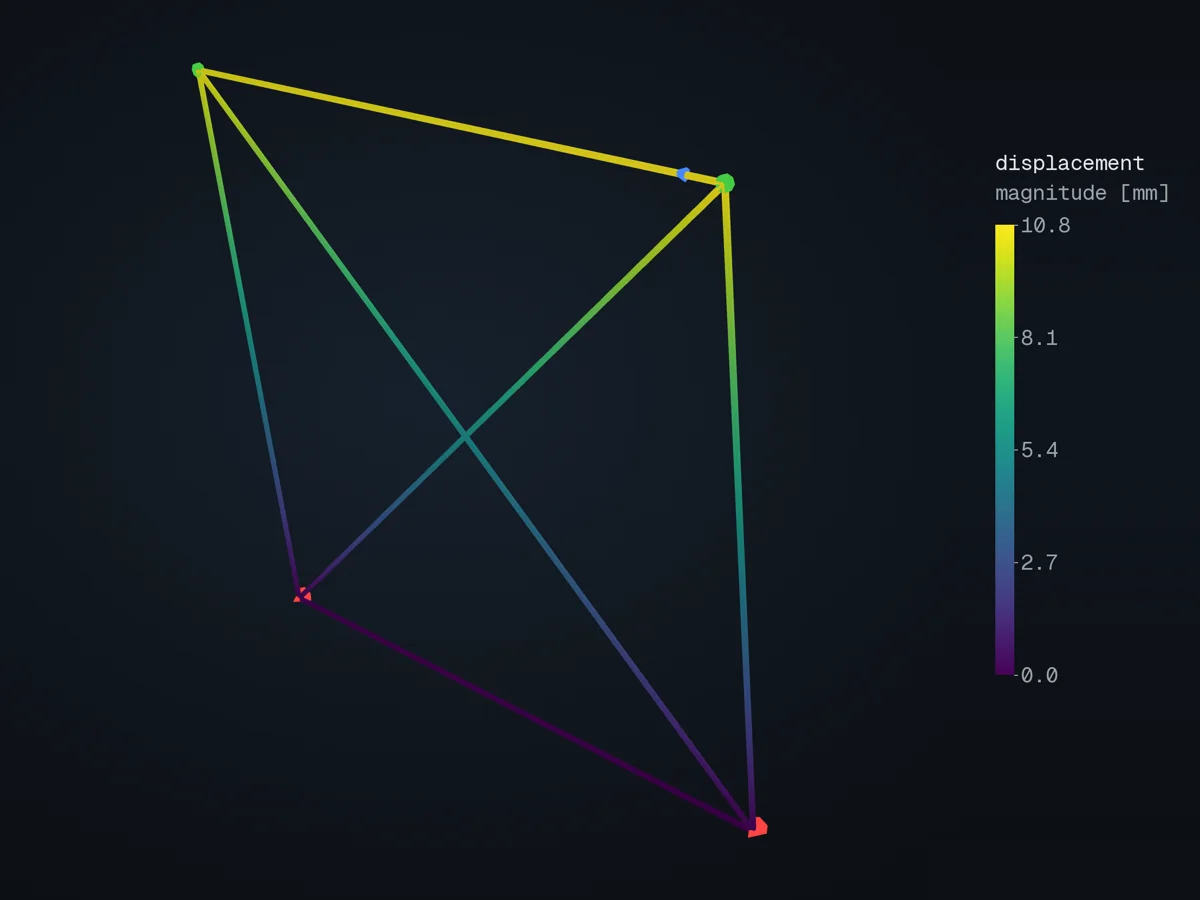
The deformed shape, coloured by displacement (magnitude [mm]), in xfea’s 3D viewer.
Open in 3D turn it, cut it, pick any field: in xfea's viewer, in your browser
The script
Section titled “The script”examples/scripts/02_core_concepts/unilateral_elements/03_cross_braced_panel.py. Run it from the repository with uv run python examples/scripts/02_core_concepts/unilateral_elements/03_cross_braced_panel.py, or, with xfea-examples installed, xfea-examples run 02_core_concepts/unilateral_elements/03_cross_braced_panel.py.
from __future__ import annotations
import mathfrom pathlib import Path
from xfea.model import (    ElasticIsotropic,    Model,    Node,    Part,    TieElement,    TieSection,    TrussElement,    TrussSection,)from xfea.problem import Problem, StaticStepfrom xfea.results import DisplacementFieldResults
from xfea_examples import out_dir

# Panel geometry — one bay, 3 m wide × 3 m tallW = 3_000.0         # [mm] bay widthH = 3_000.0         # [mm] bay heightA_CHORD = 2_000.0   # [mm²] chord/column areaA_DIAG = 200.0      # [mm²] slender tie diagonal areaP = 50_000.0        # [N]   lateral load at n_tr
steel = ElasticIsotropic(E=210_000.0, v=0.3, density=7.85e-9, name="steel")


def build_panel(tag: str) -> tuple[Model, dict[str, Node], dict[str, object]]:    model = Model(name=f"cross_braced_panel_{tag}")    part = model.add_part(Part(name="panel"))
    nodes = {        "bl": part.add_node(Node(xyz=[0.0, 0.0, 0.0])),        "br": part.add_node(Node(xyz=[W, 0.0, 0.0])),        "tl": part.add_node(Node(xyz=[0.0, 0.0, H])),        "tr": part.add_node(Node(xyz=[W, 0.0, H])),    }
    chord = TrussSection(A=A_CHORD, material=steel)    tie = TieSection(A=A_DIAG, material=steel)
    # Four bilateral chords/columns — carry compression and tension.    part.add_element(TrussElement(nodes=[nodes["bl"], nodes["br"]], section=chord))  # bottom    part.add_element(TrussElement(nodes=[nodes["tl"], nodes["tr"]], section=chord))  # top    part.add_element(TrussElement(nodes=[nodes["bl"], nodes["tl"]], section=chord))  # left col    part.add_element(TrussElement(nodes=[nodes["br"], nodes["tr"]], section=chord))  # right col
    # Tension-only diagonals.    diag_a = TieElement(nodes=[nodes["bl"], nodes["tr"]], section=tie)    diag_b = TieElement(nodes=[nodes["br"], nodes["tl"]], section=tie)    part.add_element(diag_a)    part.add_element(diag_b)
    # Pin base, clamp out-of-plane (y) on top nodes so the panel stays planar.    model.add_pin_bc(nodes=[nodes["bl"], nodes["br"]])    model.add_rollerXZ_bc(nodes=[nodes["tl"], nodes["tr"]])    return model, nodes, {"diag_a": diag_a, "diag_b": diag_b}

def _axis(n1: Node, n2: Node) -> tuple[float, float, float]:    dx = float(n2.x) - float(n1.x)    dy = float(n2.y) - float(n1.y)    dz = float(n2.z) - float(n1.z)    mag = math.sqrt(dx * dx + dy * dy + dz * dz)    return (dx / mag, dy / mag, dz / mag)

def _elongation(element, disp_field, time) -> float:    n1, n2 = element.nodes    u1 = disp_field.get_result_at(n1, time=time)    u2 = disp_field.get_result_at(n2, time=time)    du = (float(u2.x) - float(u1.x),          float(u2.y) - float(u1.y),          float(u2.z) - float(u1.z))    ax, ay, az = _axis(n1, n2)    return du[0] * ax + du[1] * ay + du[2] * az

def _axial_force(element, disp_field, time, mode: str):    L_el = float(element.length)    K = float(element.section.material.E) * float(element.section.A) / L_el    delta = _elongation(element, disp_field, time)    if mode == "tie":        N = K * delta if delta > 0 else 0.0    elif mode == "bilateral":        N = K * delta    else:        raise ValueError(mode)    return delta, K, N

def solve_case(tag: str, load_x: float) -> dict:    model, nodes, diagonals = build_panel(tag)
    problem = model.add_problem(Problem(name=f"{model.name}_run"))    step = problem.add_step(        StaticStep(            name=tag,            nlgeom=True,            initial_inc_size=0.25,            max_inc_size=1.0,            min_inc_size=1e-4,            max_increments=60,        )    )    step.add_uniform_forcefield(nodes=[nodes["tr"]], x=load_x, load_case=tag)
    disp = DisplacementFieldResults()    step.add_field_outputs([disp])
    out = Path(out_dir(model.name))    try:        problem.analyse_and_extract(path=out, verbose=False)    except Exception as exc:        return {"ok": False, "error": f"{type(exc).__name__}: {exc}"}
    STEP_END = 1.0    forces = {}    for name, element in diagonals.items():        delta, K, N = _axial_force(element, disp, STEP_END, "tie")        forces[name] = {"delta": delta, "K": K, "N": N}    # Drift = horizontal displacement of the top-right corner.    u_tr = disp.get_result_at(nodes["tr"], time=STEP_END)    drift = float(u_tr.x)    return {"ok": True, "drift": drift, "forces": forces}

def _print_case(label: str, res: dict):    print(f"--- {label} ---")    if not res["ok"]:        print(f"  solver failure: {res['error']}")        return    print(f"  top-right drift δx : {res['drift']:+.4f} mm")    for name, data in res["forces"].items():        tag = "  (slack)" if abs(data["N"]) < 1.0 else ""        print(f"  {name}: δ = {data['delta']:+.4f} mm,   "              f"N = {data['N']:+.1f} N{tag}")    print()

if __name__ == "__main__":    print("Cross-braced panel demo — 4 bilateral chord/column trusses +")    print("two TieElement diagonals, all sharing one steel ElasticIsotropic.")    print(f"  bay: {W:.0f} × {H:.0f} mm")    print(f"  chord A = {A_CHORD:.0f} mm²,  tie A = {A_DIAG:.0f} mm²")    print(f"  load: ± {P:.0f} N in x at n_tr")    print()
    # Rough analytical estimate for the single active-diagonal regime:    theta = math.atan2(H, W)    L_diag = math.hypot(W, H)    N_diag_ref = P / math.cos(theta)         # horizontal equilibrium at n_tr    K_diag = steel.E * A_DIAG / L_diag    delta_ref = N_diag_ref / K_diag    drift_ref = delta_ref / math.cos(theta)  # drift ≈ δ / cosθ    print("Single-tie-active reference (ignoring chord stretch):")    print(f"  active diagonal N ≈ P / cosθ       = {N_diag_ref:+.1f} N")    print(f"  active diagonal δ ≈ N / K          = {delta_ref:+.4f} mm")    print(f"  top drift δx      ≈ δ / cosθ       = {drift_ref:+.4f} mm")    print()
    _print_case(        "Lateral load +X at n_tr  (diag A should pull, diag B slack)",        solve_case("push_right", +P),    )    _print_case(        "Lateral load -X at n_tr  (diag A slack, diag B pulls)",        solve_case("push_left", -P),    )
print( "Interpretation:\n" " Pushing right stretches diag A (bl → tr) — it carries the\n" " full shear in tension and the frame drifts by δ / cosθ.\n" " Diag B (br → tl) would be shortened by the same motion, but\n" " a tie carries no force in compression → it goes slack and\n" " carries ≈ 0.\n" "\n" " Pushing left flips the roles. This is the canonical\n" " behaviour of a cable-braced shear wall: only ONE diagonal\n" " is active under any given load direction, so you normally\n" " provide a tie in each diagonal to cover both directions of\n" " lateral load.\n" )© 2026 Francesco Ranaudo · Text and pictures CC BY 4.0 · Code Elastic License 2.0 · how to reuse them