
Eurocode fire analysis: 500 °C isotherm — ribbed concrete slab
A YZ polygon is traced for the cross-section and extruded along X to build a 3D concrete solid:
+----------------------------------+ <- z = +120 (slab top)| || slab 120 mm || |+-----------+ +-----------+ <- z = 0 (slab soffit) \ / \ rib / trapezoidal: \ 400 / top = RIB_WIDTH_TOP \high/ bottom = RIB_WIDTH_BOTTOM \ / \/ ++ <- z = -400 (rib bottom)y=-500 -top/2 +top/2 +500Convection + radiation with the ISO 834 fire curve are applied on the full underside profile (rib bottom + rib sides + slab soffit either side of the rib). The end caps (x = 0, x = EXTRUSION_X) and the slab top (z = +120) stay adiabatic.
After the R120 transient run, the 500 °C isotherm is reported as (a) its depth along the rib centreline (the point closest to the slab soffit at y = 0 where T crosses 500 °C), and (b) its full contour traced through the section, saved to PNG and to a text file as a polyline of (y, z) points.
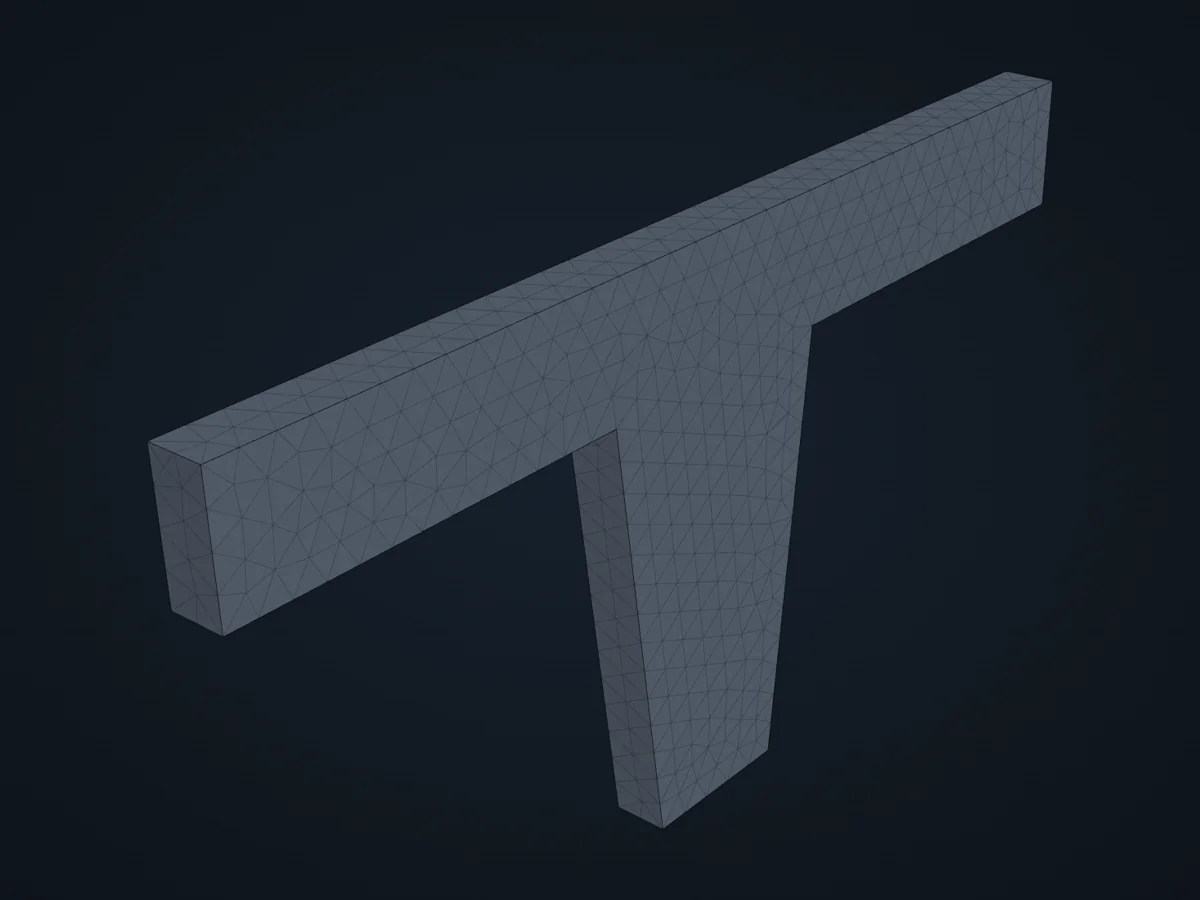
The model before it is solved: its parts, supports (red) and loads (blue).
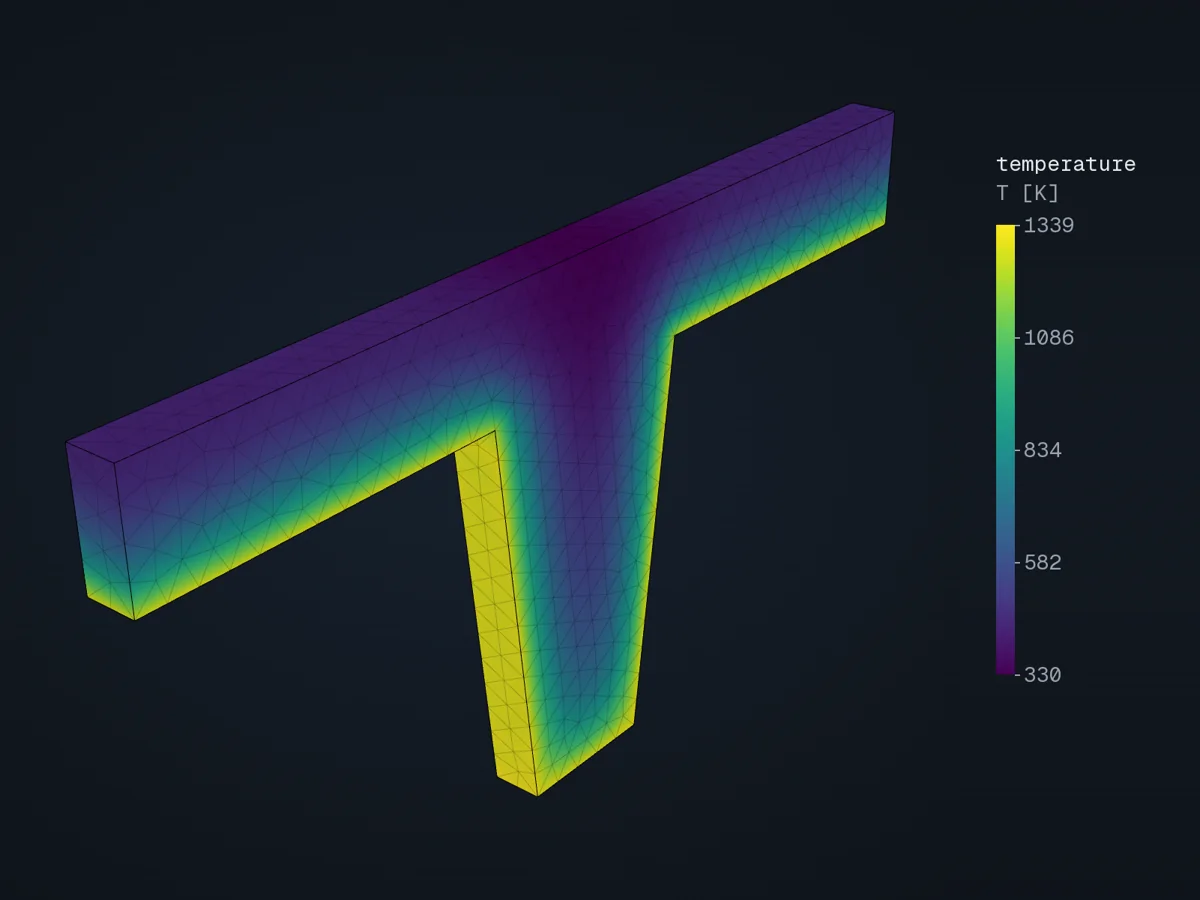
The model, coloured by temperature (T [K]), in xfea’s 3D viewer.
Open in 3D turn it, cut it, pick any field: in xfea's viewer, in your browser
The script
Section titled “The script”examples/scripts/02_core_concepts/thermal_analysis/fire_isotherm_500_ribbed_slab.py. Run it from the repository with uv run python examples/scripts/02_core_concepts/thermal_analysis/fire_isotherm_500_ribbed_slab.py, or, with xfea-examples installed, xfea-examples run 02_core_concepts/thermal_analysis/fire_isotherm_500_ribbed_slab.py.
import os
import matplotlib.pyplot as pltimport matplotlib.path as mpathimport matplotlib.tri as mtriimport numpy as np
from xfea.geometry import Polygonfrom xfea.meshing import MeshingSettingsfrom xfea.model import (    BoundaryInterface,    Convection,    Model,    Part,    Radiation,    SolidSection,    ThermalElasticIsotropic,)from xfea.problem import HeatTransferStep, Problemfrom xfea.results import TemperatureFieldResults
from xfea_examples import out_dirfrom xfea_examples.step import prism_stepfrom xfea_tools import iso834, on_bbox

# ConfigurationOUTPUT_DIR = out_dir("fire_isotherm_500_ribbed_slab")STEP_PATH = os.path.join(OUTPUT_DIR, "ribbed_slab.stp")
FIRE_DURATION = 7200      # [s] R120T_INITIAL = 293.15        # [K] 20 °CT_ISOTHERM_K = 773.15     # [K] 500 °C
# Cross-section dimensions [mm]SLAB_WIDTH = 1000SLAB_THICK = 120RIB_WIDTH_TOP = 250       # rib width at the slab soffitRIB_WIDTH_BOTTOM = 150     # rib width at the rib bottom (symmetric trapezoidal taper)RIB_HEIGHT = 400
EXTRUSION_X = 50          # [mm] depth of the extruded 3D solid along XMESH_MIN = 10             # [mm]MESH_MAX = 30             # [mm]

# Stage 1: Geometry — YZ polygon → thin extrusion in X → STEPprint("=" * 60)print("Stage 1: Geometry + Material + Mesh")print("=" * 60)

def _build_ribbed_slab_step(path):    """Write the ribbed-slab section, extruded by EXTRUSION_X, to a STEP file."""    # Polygon traced clockwise in YZ (X = 0).  Origin at slab soffit centreline.    # Rib is a symmetric trapezoid: wider at the top, narrower at the bottom.    pts_yz = [        (-SLAB_WIDTH / 2,            0.0),                            # slab soffit, far left        (-RIB_WIDTH_TOP / 2,         0.0),                            # rib top-left corner        (-RIB_WIDTH_BOTTOM / 2,      -RIB_HEIGHT),                    # rib bottom-left        ( RIB_WIDTH_BOTTOM / 2,      -RIB_HEIGHT),                    # rib bottom-right        ( RIB_WIDTH_TOP / 2,         0.0),                            # rib top-right corner        ( SLAB_WIDTH / 2,            0.0),                            # slab soffit, far right        ( SLAB_WIDTH / 2,            SLAB_THICK),                     # slab top, far right        (-SLAB_WIDTH / 2,            SLAB_THICK),                     # slab top, far left    ]    polygon = Polygon([(0.0, y, z) for (y, z) in pts_yz])
    prism_step(path, polygon.points, (EXTRUSION_X, 0.0, 0.0))    return path, polygon

step_path, polygon = _build_ribbed_slab_step(STEP_PATH)print(f"  STEP geometry: {step_path}")

# -- Concrete with EN 1992-1-2 §3.3 thermal properties --def _ec2_conductivity(T_celsius):    T100 = T_celsius / 100.0    return max(1.36 - 0.136 * T100 + 0.0057 * T100**2, 0.5)

def _ec2_specific_heat(T_celsius):    """EN 1992-1-2 §3.3.2 — siliceous concrete with u = 1.5 % moisture peak.
    Dry curve (§3.3.2(1)): 900 → 1000 → 1100 J/(kg·K) at 100 / 200 / 400 °C.    Moisture peak (§3.3.2(2), default u = 1.5 %): rises from 900 at 100 °C to    c_p,peak = 1470 at 115 °C, then drops linearly back to the dry curve    value (1000) at 200 °C.    """    if T_celsius <= 100:        return 900.0    if T_celsius <= 115:        return 900.0 + (1470.0 - 900.0) * (T_celsius - 100) / 15.0    if T_celsius <= 200:        return 1470.0 + (1000.0 - 1470.0) * (T_celsius - 115) / 85.0    if T_celsius <= 400:        return 1000.0 + (T_celsius - 200) / 2.0    return 1100.0

# Sample densely between 100 and 200 °C so the moisture peak at 115 °C is# captured by the piecewise-linear table the solver interpolates from._temps_C = sorted(set(    list(range(20, 101, 20))    + list(range(100, 201, 5))    + list(range(200, 1201, 50))))k_table = [(_ec2_conductivity(T), T + 273.15) for T in _temps_C]# SI-mm: c [mJ/(t·K)] = c [J/(kg·K)] × 1e6c_table = [(_ec2_specific_heat(T) * 1e6, T + 273.15) for T in _temps_C]
mat = ThermalElasticIsotropic(    k=k_table,    c=c_table,    E=30_000,        # [MPa]    structural, unused in pure heat transfer    v=0.2,    density=2.3e-9,  # [t/mm^3] (= 2300 kg/m^3))sec = SolidSection(material=mat)
model = Model(name="fire_isotherm_500_ribbed_slab")part = model.add_part(Part(name="ribbed_slab"))part.base_geometry = step_pathpart.mesh(settings=MeshingSettings(min=MESH_MIN, max=MESH_MAX), section=sec)print(f"  Mesh: {len(list(part.nodes))} nodes, {len(list(part.elements))} elements")

# Stage 2: Boundary conditions (fire exposure)print(f"\n{'=' * 60}")print("Stage 2: Boundary conditions (fire exposure)")print("=" * 60)
fire_curve = iso834(FIRE_DURATION, dt=60, name="ISO834")
# Underside profile = boundary faces that are NOT one of:#   - the slab top (z = +120 = bbox zmax)#   - the front/back caps of the prism (x = 0/EXTRUSION_X = bbox xmin/xmax)#   - the slab end faces (y = ±SLAB_WIDTH/2 = bbox ymin/ymax) — these#     represent cuts through a continuous slab, not exposed surfacesboundary_faces = part.find_boundary_faces()fire_faces = boundary_faces.subgroup(    lambda f: not on_bbox(f, "zmax")    and not on_bbox(f, "xmin")    and not on_bbox(f, "xmax")    and not on_bbox(f, "ymin")    and not on_bbox(f, "ymax"))fire_surface = part.add_group(fire_faces)fire_surface.name = "fire_exposed"print(f"  Fire-exposed surface: {len(list(fire_faces.faces))} faces")
# EN 1991-1-2 §3.1: h_c = 25 W/(m^2·K), eps = 0.7convection = Convection(    h=25.0e-3,                                     # [mW/(mm^2·K)]    temperature_value=1.0,    temperature_amplitude=fire_curve,)radiation = Radiation(    eps=0.7,    temperature_value=1.0,    temperature_amplitude=fire_curve,)model.add_interface(BoundaryInterface(master=fire_surface, behavior=convection))model.add_interface(BoundaryInterface(master=fire_surface, behavior=radiation))model.add_uniform_thermal_ics_field(T0=T_INITIAL, nodes=part.nodes)

# Stage 3: Transient heat transfer analysis (R120)print(f"\n{'=' * 60}")print("Stage 3: Transient heat transfer analysis (R120)")print("=" * 60)
problem = model.add_problem(Problem(name="fire_R120"))step = problem.add_step(    HeatTransferStep(        name="fire_exposure",        time=FIRE_DURATION,        initial_inc_size=2,        min_inc_size=0.1,        max_inc_size=60,        max_increments=10000,        max_temp_delta=50,        steady_state=False,    ))
temp = TemperatureFieldResults()step.add_field_outputs([temp])
print("  Running transient heat transfer analysis...")problem.analyse_and_extract(path=OUTPUT_DIR, verbose=True)
min_T = temp.get_min_result("T", time=FIRE_DURATION)max_T = temp.get_max_result("T", time=FIRE_DURATION)print(    f"\n  Final temperatures: min = {float(min_T.T):.1f} K "    f"({float(min_T.T) - 273.15:.1f} °C), "    f"max = {float(max_T.T):.1f} K ({float(max_T.T) - 273.15:.1f} °C)")

# 500 °C isotherm — section view (YZ projection of the 3D field)print(f"\n{'=' * 60}")print(f"500 °C isotherm: locating T = {T_ISOTHERM_K} K")print("=" * 60)
# Collect nodal results.  Faces at x = 0 and x = EXTRUSION_X are adiabatic so# the 3D temperature field is x-invariant in the limit of fine x-discretisation.# We project to YZ for the section view by binning nodes on the (y, z) plane# and averaging T over their X copies.final_results = temp.get_results(time=FIRE_DURATION)y_all = np.array([r.location._y for r in final_results])z_all = np.array([r.location._z for r in final_results])t_all = np.array([float(r.T) - 273.15 for r in final_results])         # [°C]
bin_tol = 0.5  # [mm]keys = np.column_stack((np.round(y_all / bin_tol),                        np.round(z_all / bin_tol))).astype(np.int64)keys_view = keys.view([("y", keys.dtype), ("z", keys.dtype)]).ravel()unique_keys, inverse = np.unique(keys_view, return_inverse=True)
ys = np.zeros(len(unique_keys))zs = np.zeros(len(unique_keys))ts = np.zeros(len(unique_keys))counts = np.zeros(len(unique_keys))for i, idx in enumerate(inverse):    ys[idx] += y_all[i]    zs[idx] += z_all[i]    ts[idx] += t_all[i]    counts[idx] += 1ys /= countszs /= countsts /= counts
# --- (a) depth of 500 °C isotherm along the rib centreline (y = 0) ---centre = np.abs(ys) < bin_tolz_centre = zs[centre]t_centre = ts[centre]order = np.argsort(z_centre)z_sorted = z_centre[order]t_sorted = t_centre[order]
# Walk from the slab top (cool) downwards toward the rib bottom (hot) until# T crosses 500 °C.  This pins the *uppermost* crossing — the deepest point# of the 500 °C isotherm on the rib centreline.crossing_z = Nonefor i in range(len(z_sorted) - 1, 0, -1):    t_hi, t_lo = t_sorted[i], t_sorted[i - 1]    if (t_hi - 500.0) * (t_lo - 500.0) <= 0.0 and t_hi != t_lo:        frac = (500.0 - t_hi) / (t_lo - t_hi)        crossing_z = z_sorted[i] + frac * (z_sorted[i - 1] - z_sorted[i])        break
if crossing_z is None:    print("  Rib centreline never crosses 500 °C.")    centreline_depth = Noneelse:    centreline_depth = SLAB_THICK - crossing_z   # measured down from slab top    print(f"  Rib centreline (y = 0):")    print(f"    z at 500 °C                = {crossing_z:+.1f} mm")    print(f"    depth from slab top        = {centreline_depth:.1f} mm")    print(f"    height above rib bottom    = {crossing_z + RIB_HEIGHT:.1f} mm")
# --- (b) build a triangulation masked to the section polygon ---section_outline_y = np.array([    -SLAB_WIDTH / 2, -RIB_WIDTH_TOP / 2, -RIB_WIDTH_BOTTOM / 2,     RIB_WIDTH_BOTTOM / 2,   RIB_WIDTH_TOP / 2,  SLAB_WIDTH / 2,     SLAB_WIDTH / 2, -SLAB_WIDTH / 2,])section_outline_z = np.array([    0.0, 0.0, -RIB_HEIGHT, -RIB_HEIGHT, 0.0, 0.0,    SLAB_THICK, SLAB_THICK,])section_path = mpath.Path(np.column_stack((section_outline_y, section_outline_z)))
triang = mtri.Triangulation(ys, zs)tri_centroids = np.column_stack((    ys[triang.triangles].mean(axis=1),    zs[triang.triangles].mean(axis=1),))mask = ~section_path.contains_points(tri_centroids)triang.set_mask(mask)
# EN 1992-1-2 insulation-criterion threshold: ΔT ≤ 140 K above the initial# temperature.  Concrete below this threshold has effectively not been# affected by the fire.T_INSULATION_C = (T_INITIAL + 140.0) - 273.15        # = 160 °C with T0 = 20 °C
# --- (c) plot ---fig, ax = plt.subplots(figsize=(10, 8))filled = ax.tricontourf(triang, ts, levels=32, cmap="hot_r")fig.colorbar(filled, ax=ax, label="Temperature [°C]")contour = ax.tricontour(triang, ts, levels=[500.0], colors="cyan", linewidths=2)
# Green overlay: T ≤ T0 + 140 K (EN 1992-1-2 insulation criterion).# Hatching ensures the region is visible against the light-yellow background# even where the underlying colormap value is already pale.ax.tricontourf(    triang, ts,    levels=[float(ts.min()) - 1.0, T_INSULATION_C],    colors=["limegreen"],    alpha=0.55,    hatches=["///"],)ax.tricontour(triang, ts, levels=[T_INSULATION_C],              colors="darkgreen", linewidths=1.8)
ax.plot(np.append(section_outline_y, section_outline_y[0]),        np.append(section_outline_z, section_outline_z[0]),        "k-", linewidth=1.2)
ax.set_xlabel("y [mm]")ax.set_ylabel("z [mm]")ax.set_title(    f"EN 1992-1-2 — Ribbed slab, ISO 834 R{FIRE_DURATION // 60}\n"    f"500 °C isotherm (cyan), T ≤ T₀ + 141 K (green)")ax.set_aspect("equal")ax.grid(True, alpha=0.3)fig.tight_layout()
plot_path = os.path.join(OUTPUT_DIR, "isotherm_500_yz.png")fig.savefig(plot_path, dpi=150)plt.close(fig)print(f"  Plot saved: {plot_path}")
# Dump the contour polylines (one per disconnected segment) to a text file.contour_path = os.path.join(OUTPUT_DIR, "isotherm_500_polyline.txt")with open(contour_path, "w") as fh:    fh.write(f"# 500 C isotherm (section view) after R{FIRE_DURATION // 60} ISO 834 fire\n")    fh.write("# y[mm]  z[mm]   (one segment per blank-line separated block)\n")    n_segments = 0    n_vertices = 0    for path in contour.get_paths():        verts = path.vertices        if len(verts) == 0:            continue        n_segments += 1        for y, z in verts:            fh.write(f"{y:10.3f} {z:10.3f}\n")            n_vertices += 1        fh.write("\n")print(f"  Polyline saved: {contour_path}  ({n_segments} segments, {n_vertices} vertices)")

# Summaryprint(f"\n{'=' * 60}")print("Summary — EN 1992-1-2 500 °C isotherm method")print("=" * 60)print(f" Fire curve: ISO 834")print(f" Exposure: {FIRE_DURATION / 60:.0f} min (R{FIRE_DURATION // 60})")print(f" Section: slab {SLAB_WIDTH} x {SLAB_THICK} mm,")print(f" rib {RIB_WIDTH_TOP}/{RIB_WIDTH_BOTTOM} (top/bot) " f"x {RIB_HEIGHT} mm (trapezoidal downstand)")print(f" Extrusion (X): {EXTRUSION_X} mm")print(f" Convection: h = 25 W/(m^2 K)")print(f" Radiation: eps = 0.7")print(f" Max temperature: {float(max_T.T) - 273.15:.0f} °C")print(f" Min temperature: {float(min_T.T) - 273.15:.0f} °C")if centreline_depth is not None: print(f" 500 °C @ rib centreline: z = {crossing_z:+.1f} mm " f"({centreline_depth:.1f} mm below slab top)")print(f" Output directory: {OUTPUT_DIR}")© 2026 Francesco Ranaudo · Text and pictures CC BY 4.0 · Code Elastic License 2.0 · how to reuse them