
Eurocode fire analysis: 500 °C isotherm method — Part 1: Analysis
This script runs the transient heat-transfer analysis for the EN 1992-1-2 simplified assessment workflow:
- Define a concrete slab with temperature-dependent thermal properties per EN 1992-1-2 §3.3 (conductivity, specific heat, density).
- Apply the ISO 834 standard fire curve on the exposed face via convection (h = 25 W/m²K) and radiation (ε = 0.7) as per EN 1991-1-2.
- Run a transient heat-transfer analysis for R120 (120 min).
- Visualise the temperature field with the 500 °C isotherm highlighted and generate cross-section plots.
The mesh is checkpointed after meshing (mesh.pkl) so that re-runs
skip the expensive meshing step. Delete it to force a re-mesh.
BCs and problem definition are always re-applied (cheap, change often).
The companion script fire_isotherm_500_postprocess.py imports the
converged results and builds the reduced cross-section geometry.

The model before it is solved: its parts, supports (red) and loads (blue).
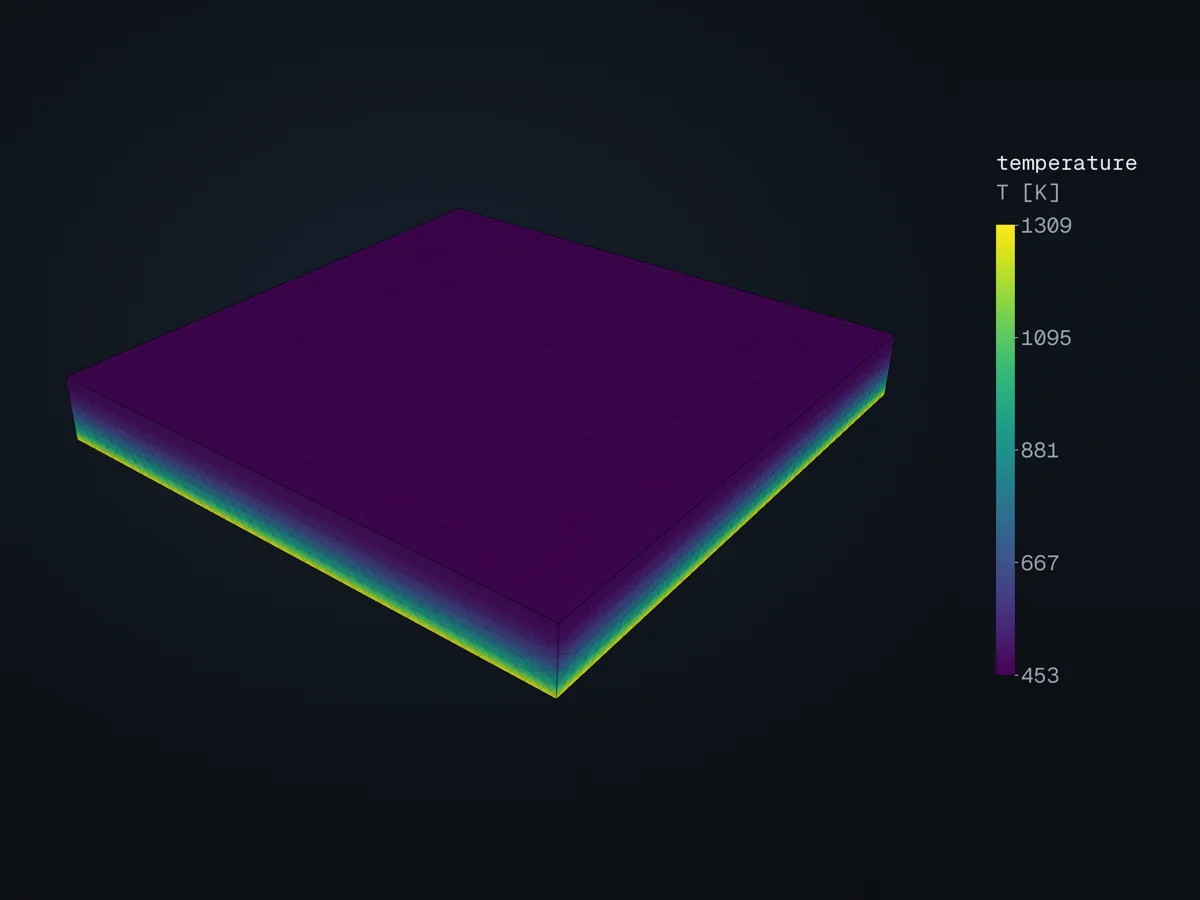
The model, coloured by temperature (T [K]), in xfea’s 3D viewer.
Open in 3D turn it, cut it, pick any field: in xfea's viewer, in your browser
The script
Section titled “The script”examples/scripts/02_core_concepts/thermal_analysis/fire_isotherm_500.py. Run it from the repository with uv run python examples/scripts/02_core_concepts/thermal_analysis/fire_isotherm_500.py, or, with xfea-examples installed, xfea-examples run 02_core_concepts/thermal_analysis/fire_isotherm_500.py.
import os
import matplotlib.pyplot as pltimport numpy as np
from xfea.meshing import MeshingSettingsfrom xfea.model import BoundaryInterfacefrom xfea.model import Convectionfrom xfea.model import Modelfrom xfea.model import Partfrom xfea.model import Radiationfrom xfea.model import SolidSectionfrom xfea.model import ThermalElasticIsotropicfrom xfea.problem import HeatTransferStepfrom xfea.problem import Problemfrom xfea.results import TemperatureFieldResultsfrom xfea_examples import show_viewer
from xfea_examples import out_dirfrom xfea_examples.step import box_stepfrom xfea_tools import iso834from xfea_tools import on_bboxfrom xfea_tools import faces_to_mesh_object

OUTPUT_DIR = out_dir("fire_isotherm_500")MESH_PKL = os.path.join(OUTPUT_DIR, "mesh.pkl")MODEL_PKL = os.path.join(OUTPUT_DIR, "model.pkl")
FIRE_DURATION = 7200  # [s] fire exposure duration (120 min = R120)T_INITIAL = 293.15    # [K] initial uniform temperature (20 °C)

# Geometrywidth = 1000    # [mm] slab widthdepth = 1000    # [mm] slab depthheight = 120    # [mm] slab height (thickness)mesh_min = 10   # [mm] target min element sizemesh_max = 25   # [mm] target max element size

# Stage 1: Geometry + Material + Mesh  (checkpointed → mesh.pkl)print("=" * 60)print("Stage 1: Geometry + Material + Mesh")print("=" * 60)
if os.path.exists(MESH_PKL):    print(f"  Loading mesh checkpoint: {MESH_PKL}")    model = Model.from_pickle(MESH_PKL)else:    # The column's geometry, written as a STEP file next to the results    step_path = box_step(os.path.join(OUTPUT_DIR, "fire_column.stp"), width, depth, height)
    # -- Material: concrete with temperature-dependent properties (EN 1992-1-2 §3.3) --    def _ec2_conductivity(T_celsius):        """EN 1992-1-2 Eq. 3.5 — lower limit of thermal conductivity [W/(m·K)]."""        T100 = T_celsius / 100.0        return max(1.36 - 0.136 * T100 + 0.0057 * T100**2, 0.5)
    def _ec2_specific_heat(T_celsius):        """EN 1992-1-2 §3.3.2 — specific heat of siliceous concrete [J/(kg·K)]."""        if T_celsius <= 100:            return 900.0        elif T_celsius <= 200:            return 900.0 + (T_celsius - 100)        elif T_celsius <= 400:            return 1000.0 + (T_celsius - 200) / 2.0        else:            return 1100.0
    _temps_C = list(range(20, 1201, 50))    k_table = [(_ec2_conductivity(T), T + 273.15) for T in _temps_C]    # SI-mm: energy = mJ, mass = tonne → c [mJ/(tonne·K)] = c [J/(kg·K)] × 1e6    c_table = [(_ec2_specific_heat(T) * 1e6, T + 273.15) for T in _temps_C]
    # Concrete structural properties (SI-mm) — present but unused in pure heat transfer    E_conc = 30_000      # [MPa]     Young's modulus    v_conc = 0.2         # [-]       Poisson's ratio    rho_conc = 2.3e-9    # [t/mm^3]  mass density (2300 kg/m^3)
    mat = ThermalElasticIsotropic(        k=k_table,        c=c_table,        E=E_conc,        v=v_conc,        density=rho_conc,    )    sec = SolidSection(material=mat)
    model = Model(name="fire_isotherm_500")    part = model.add_part(Part(name="column"))    part.base_geometry = step_path    part.mesh(settings=MeshingSettings(min=mesh_min, max=mesh_max), section=sec)
    # Save mesh checkpoint (no BCs, no Problem — just the expensive bit)    model.to_pickle(MESH_PKL, summary=False)    print(f"  Mesh checkpoint saved: {MESH_PKL}")
part = list(model.parts)[0]print(f"  Mesh: {len(list(part.nodes))} nodes, {len(list(part.elements))} elements")

# Stage 2: Boundary conditions  (always re-applied — cheap, change often)print(f"\n{'=' * 60}")print("Stage 2: Boundary conditions (fire exposure)")print("=" * 60)
# ISO 834 fire curve amplitudefire_curve = iso834(FIRE_DURATION, dt=60, name="ISO834")
# Select exposed faces (bottom face, z=0)boundary_faces = part.find_boundary_faces()fire_faces = boundary_faces.subgroup(lambda f: on_bbox(f, "zmin"))fire_surface = part.add_group(fire_faces)fire_surface.name = "fire_exposed"print(f"  Fire-exposed surface: {len(list(fire_faces.faces))} faces")
# Convection: α_c = 25 W/(m²·K) per EN 1991-1-2 §3.1h_conv = 25.0e-3    # [mW/(mm^2*K)] convection coefficient (= 25 W/(m^2*K))convection = Convection(    h=h_conv,    temperature_value=1.0,    temperature_amplitude=fire_curve,)model.add_interface(BoundaryInterface(master=fire_surface, behavior=convection))
# Radiation: ε = 0.7 (ε_m × ε_f, EN 1991-1-2 §3.1)emissivity = 0.7    # [-] combined surface/flame emissivityradiation = Radiation(    eps=emissivity,    temperature_value=1.0,    temperature_amplitude=fire_curve,)model.add_interface(BoundaryInterface(master=fire_surface, behavior=radiation))
# Initial temperaturemodel.add_uniform_thermal_ics_field(T0=T_INITIAL, nodes=part.nodes)

# Stage 3: Problem definition + Analysisprint(f"\n{'=' * 60}")print("Stage 3: Transient heat transfer analysis")print("=" * 60)
problem = model.add_problem(Problem(name="fire_R120"))step = problem.add_step(    HeatTransferStep(        name="fire_exposure",        time=FIRE_DURATION,        initial_inc_size=2,        min_inc_size=0.1,        max_inc_size=60,        max_increments=10000,        max_temp_delta=50,        steady_state=False,    ))
temp = TemperatureFieldResults()step.add_field_outputs([temp])
print("  Running transient heat transfer analysis...")problem.analyse_and_extract(path=OUTPUT_DIR, verbose=True)
# Query the final time step onlymin_T = temp.get_min_result("T", time=FIRE_DURATION)max_T = temp.get_max_result("T", time=FIRE_DURATION)print(f"\n  Final temperatures: min = {float(min_T.T):.1f} K ({float(min_T.T) - 273.15:.1f} °C), "      f"max = {float(max_T.T):.1f} K ({float(max_T.T) - 273.15:.1f} °C)")
# Save the full model (mesh + BCs + Problem with path to results DB).# summary.json is auto-generated alongside — human-readable record of# what is inside the pickle.model.to_pickle(MODEL_PKL)print(f"  Model saved: {MODEL_PKL}")print(f"  Summary:     {MODEL_PKL.replace('.pkl', '.json')}")

# 500 °C isotherm — count elements above/below thresholdT_ISOTHERM = 773.15  # [K] 500 °C isotherm threshold
print(f"\n{'=' * 60}")print(f"500 °C isotherm: identifying elements where T > {T_ISOTHERM} K")print("=" * 60)
# Build a node-temperature lookup from the FINAL time step onlyfinal_results = temp.get_results(time=FIRE_DURATION)node_temps = {}for r in final_results:    loc = r.location    if loc is not None:        node_temps[loc.key] = float(r.T)
# Classify elements by averaging their nodal temperaturesn_orig = 0n_hot = 0hot_element_keys = set()for element in part.elements:    n_orig += 1    vals = [node_temps.get(n.key) for n in element.nodes if n.key in node_temps]    if vals and (sum(vals) / len(vals)) > T_ISOTHERM:        n_hot += 1        hot_element_keys.add(element.key)
n_cold = n_orig - n_hotprint(f"  Original:  {n_orig} elements")print(f"  T > 500 C: {n_hot} elements ({n_hot/n_orig:.1%})")print(f"  T < 500 C: {n_cold} elements ({n_cold/n_orig:.1%})")

# Viewer — colour elements above 500 °Chot_faces = boundary_faces.subgroup(    lambda f: f.element.key in hot_element_keys)hot_highlight = faces_to_mesh_object(    hot_faces,    color=(1.0, 0.15, 0.0),    opacity=0.85,    name="hot_zone_T>500C",    offset=0.3,)
# Opens the viewer when asked to (XFEA_EXAMPLES_SHOW_VIEWER=1); in an unattended run it would wait for ever.show_viewer(model, results={temp: "T"}, units="K", highlights=[hot_highlight])


# Cross-section plotsprint(f"\n{'=' * 60}")print("Generating cross-section plots")print("=" * 60)
fig, axes = plt.subplots(1, 2, figsize=(14, 6))
xs = np.array([r.location._x for r in final_results])ys = np.array([r.location._y for r in final_results])zs = np.array([r.location._z for r in final_results])ts = np.array([float(r.T) - 273.15 for r in final_results])
# --- Panel 1: Temperature field at mid-section (y = depth/2) ---mask_y = np.abs(ys - depth / 2) < 30tri = axes[0].tricontourf(xs[mask_y], zs[mask_y], ts[mask_y], levels=32, cmap="hot_r")fig.colorbar(tri, ax=axes[0], label="Temperature [°C]")try:    axes[0].tricontour(xs[mask_y], zs[mask_y], ts[mask_y],                       levels=[500], colors="cyan", linewidths=2)except Exception:    passaxes[0].set_xlabel("x [mm]")axes[0].set_ylabel("z [mm] (distance from fire face)")axes[0].set_title(f"Temperature at y = {depth/2:.0f} mm (t = {FIRE_DURATION/60:.0f} min)")axes[0].set_aspect("equal")
# --- Panel 2: Temperature profile through depth ---centre_mask = (np.abs(xs - width / 2) < 20) & (np.abs(ys - depth / 2) < 20)z_line = zs[centre_mask]t_line = ts[centre_mask]sort_idx = np.argsort(z_line)axes[1].plot(z_line[sort_idx], t_line[sort_idx], "r-o", markersize=3, label="FEA")axes[1].axhline(y=500, color="cyan", linestyle="--", linewidth=2, label="500 °C isotherm")axes[1].set_xlabel("z [mm] (distance from fire face)")axes[1].set_ylabel("Temperature [°C]")axes[1].set_title("Temperature Profile Through Depth")axes[1].legend()axes[1].grid(True, alpha=0.3)
fig.suptitle(    f"EN 1992-1-2 — ISO 834 Fire Exposure (R{FIRE_DURATION//60})",    fontsize=14, fontweight="bold",)fig.tight_layout()
plot_path = os.path.join(OUTPUT_DIR, "fire_isotherm_500.png")fig.savefig(plot_path, dpi=150)print(f"  Plot saved: {plot_path}")plt.close(fig)

# Summaryprint(f"\n{'=' * 60}")print("EN 1992-1-2 — 500 °C Isotherm Method Summary")print("=" * 60)print(f" Fire curve: ISO 834")print(f" Exposure: {FIRE_DURATION/60:.0f} min (R{FIRE_DURATION//60})")print(f" Section: {width} x {depth} x {height} mm")print(f" Concrete: EN 1992-1-2 properties (lower-limit conductivity)")print(f" Convection: h = 25 W/(m^2 K)")print(f" Radiation: eps = 0.7")print(f" Max temperature: {float(max_T.T) - 273.15:.0f} C")print(f" Min temperature: {float(min_T.T) - 273.15:.0f} C")print(f" Original elements: {n_orig}")print(f" T > 500 C: {n_hot} elements ({n_hot/n_orig:.1%})")print(f" T < 500 C: {n_cold} elements ({n_cold/n_orig:.1%})")print(f" Output directory: {OUTPUT_DIR}")© 2026 Francesco Ranaudo · Text and pictures CC BY 4.0 · Code Elastic License 2.0 · how to reuse them