
Masonry/concrete infill panel in a steel frame — application demo
Part 7 of the unilateral-elements series; the 2D counterpart of
03_cross_braced_panel.py.
A one-bay moment-resisting steel frame (four BeamElement members
with rectangular section) is infilled with a single plain-concrete
panel modelled as one four-node CompressionOnlyMembraneElement,
which carries no force in tension.
Under lateral load the panel mobilises a diagonal compressive strut
from the loaded top corner down to the opposite base corner — the
classic equivalent-strut picture of infilled frames. When the load
is reversed the strut flips to the other diagonal. The same panel
carries both cases because its nonlinearity is directional
(principal-stress cutoff), not element-level: the tensile diagonal
of the panel simply slacks out while the compressive diagonal
stiffens the frame.
n_tl ─────── top chord ─────── n_tr ← lateral load ±P applied here │ │ │ ░░░░░░░░░░░░░░░ │ │ ░░░░░░░░░░░░░░░ │ │ ░ concrete ░ │ │ ░ infill ░ │ columns and chords are steel │ ░░░░░░░░░░░░░░░ │ beams (rectangular section, │ ░░░░░░░░░░░░░░░ │ fixed base); the bay is filled │ │ with a single │ │ CompressionOnlyMembraneElement. n_bl ──── bottom chord ──── n_br (both fixed)Three cases are solved: (a) bare frame, +P at n_tr (no infill — just the portal frame). (b) infilled frame, +P at n_tr (panel activates strut bl→tr). (c) infilled frame, −P at n_tr (panel activates strut br→tl).
Expected outcome: the infill drastically reduces top-corner drift compared to the bare frame (the panel contributes a diagonal-strut stiffness on top of the frame’s 12EI/L³ lateral stiffness), and cases (b) and (c) give equal drift magnitudes by symmetry.
Why beams instead of trusses for the frame: a rectangle of four pin- jointed trusses (no diagonal) is a kinematic mechanism under lateral load — zero stiffness, nothing converges. Real infilled frames have moment-resisting columns anyway, so beams are the physically correct choice for this demo.
Units: mm / N / MPa.
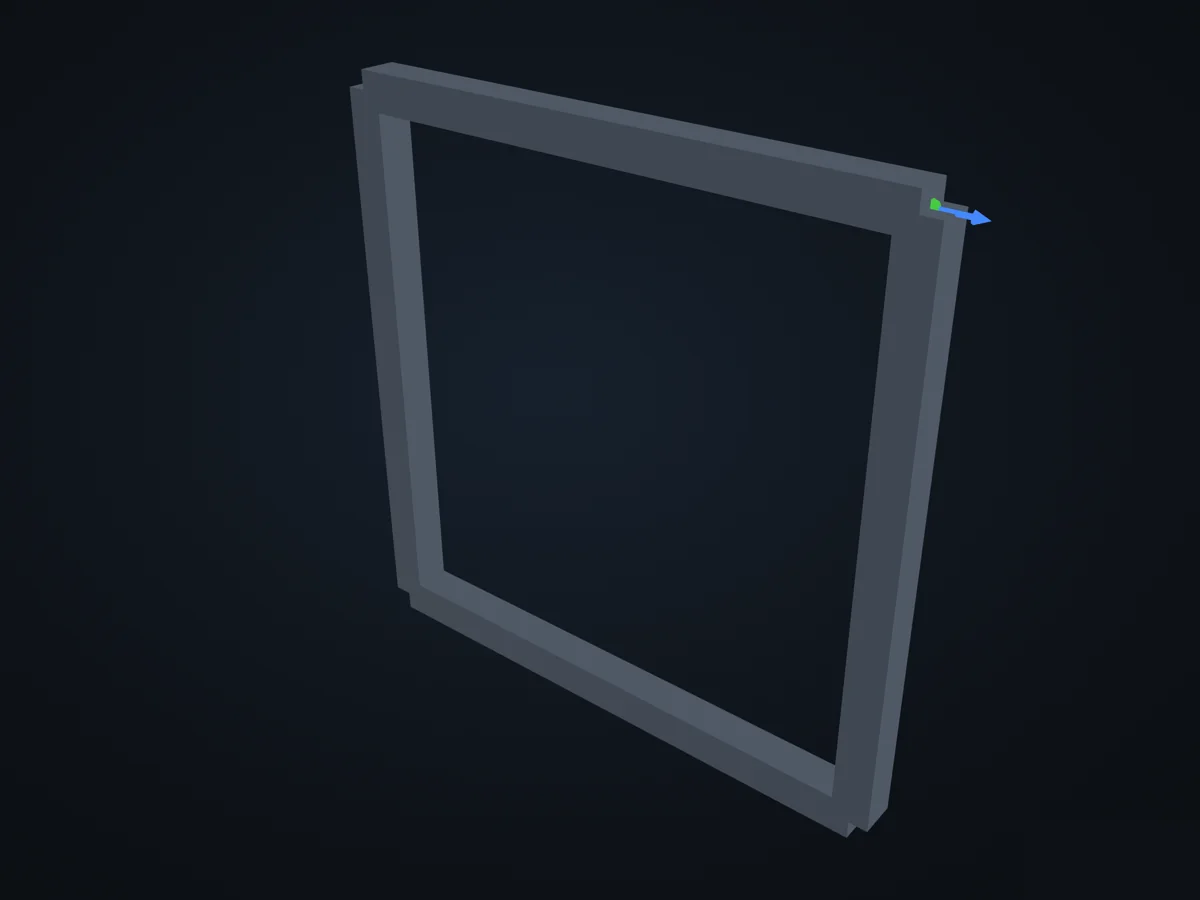
The model before it is solved: its parts, supports (red) and loads (blue).
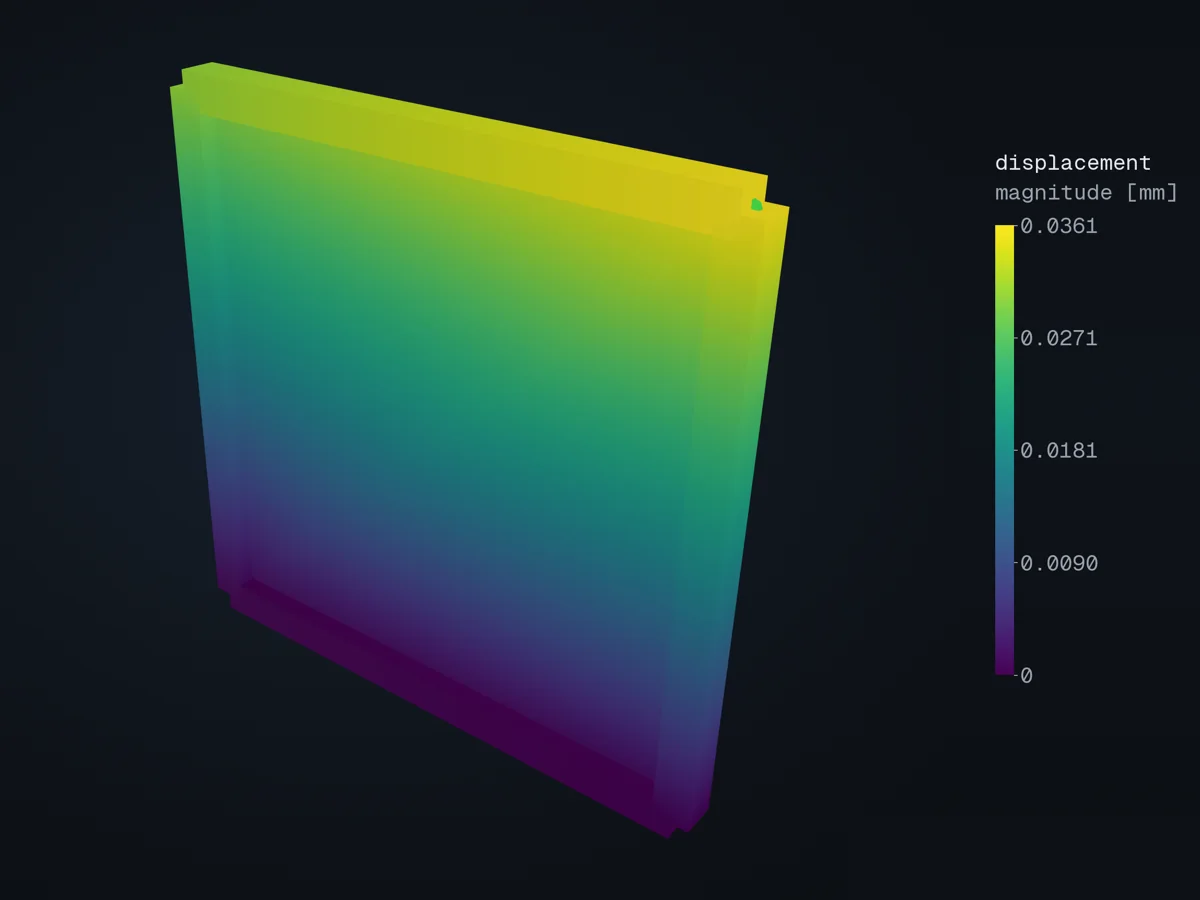
The model, coloured by displacement (magnitude [mm]), in xfea’s 3D viewer.
Open in 3D turn it, cut it, pick any field: in xfea's viewer, in your browser
The script
Section titled “The script”examples/scripts/02_core_concepts/unilateral_elements/07_infill_panel_frame.py. Run it from the repository with uv run python examples/scripts/02_core_concepts/unilateral_elements/07_infill_panel_frame.py, or, with xfea-examples installed, xfea-examples run 02_core_concepts/unilateral_elements/07_infill_panel_frame.py.
from __future__ import annotations
import mathfrom pathlib import Path
from xfea.model import (    BeamElement,    CompressionOnlyMembraneElement,    CompressionOnlyMembraneSection,    ElasticIsotropic,    Model,    Node,    Part,    RectangularSection,)from xfea.problem import Problem, StaticStepfrom xfea.results import DisplacementFieldResults
from xfea_examples import out_dir

# Geometry / materials / loadW = 3_000.0             # [mm] bay widthH = 3_000.0             # [mm] bay heightW_COL = 200.0           # [mm] column / chord widthH_COL = 200.0           # [mm] column / chord depth (strong axis = out of plane)T_INFILL = 150.0        # [mm]  infill panel thicknessP = 50_000.0            # [N]   lateral load at n_tr
steel = ElasticIsotropic(E=210_000.0, v=0.3, density=7.85e-9, name="steel")concrete = ElasticIsotropic(E=30_000.0, v=0.2, density=2.4e-9, name="concrete")


def build_frame(tag: str, *, with_infill: bool) -> tuple[Model, dict[str, Node]]:    """Build the one-bay frame, optionally adding a compression-only    infill panel.
    The four corner nodes are shared between the truss chords and the    panel's membrane element, so no tie-MPC is needed: the panel is    naturally bonded to the frame through its corners.    """    model = Model(name=f"infill_frame_{tag}")    part = model.add_part(Part(name="frame"))
    nodes = {        "bl": part.add_node(Node(xyz=[0.0, 0.0, 0.0])),        "br": part.add_node(Node(xyz=[W, 0.0, 0.0])),        "tl": part.add_node(Node(xyz=[0.0, 0.0, H])),        "tr": part.add_node(Node(xyz=[W, 0.0, H])),    }
    section = RectangularSection(w=W_COL, h=H_COL, material=steel)    # Orientation = [0, 1, 0]: local y axis of the beam section points    # out of the frame plane, so bending about the strong axis occurs    # in the xz plane (the loading plane).    orient = [0, 1, 0]    part.add_element(BeamElement(nodes=[nodes["bl"], nodes["br"]], section=section, orientation=orient))    part.add_element(BeamElement(nodes=[nodes["tl"], nodes["tr"]], section=section, orientation=orient))    part.add_element(BeamElement(nodes=[nodes["bl"], nodes["tl"]], section=section, orientation=orient))    part.add_element(BeamElement(nodes=[nodes["br"], nodes["tr"]], section=section, orientation=orient))
    if with_infill:        infill = CompressionOnlyMembraneSection(t=T_INFILL, material=concrete)        # Counter-clockwise node order as seen from +y (the frame sits        # in the xz plane); avoids a negative Jacobian.        part.add_element(            CompressionOnlyMembraneElement(                nodes=[nodes["bl"], nodes["br"], nodes["tr"], nodes["tl"]],                section=infill,            )        )
    # Fix the base in all 6 DOF (moment-resisting column base). The    # top nodes are left free in plane so the frame can drift under    # the lateral load, but restrained out-of-plane so the membrane    # (which has no bending stiffness) stays flat.    model.add_fix_bc(nodes=[nodes["bl"], nodes["br"]])    model.add_rollerXZ_bc(nodes=[nodes["tl"], nodes["tr"]])    return model, nodes

def solve_case(tag: str, *, with_infill: bool, load_x: float) -> dict:    model, nodes = build_frame(tag, with_infill=with_infill)
    problem = model.add_problem(Problem(name=f"{model.name}_run"))    step = problem.add_step(        StaticStep(            name=tag,            nlgeom=True,            initial_inc_size=0.25,            max_inc_size=1.0,            min_inc_size=1e-4,            max_increments=60,        )    )    step.add_uniform_forcefield(nodes=[nodes["tr"]], x=load_x, load_case=tag)
    disp = DisplacementFieldResults()    step.add_field_outputs([disp])
    out = Path(out_dir(model.name))    try:        problem.analyse_and_extract(path=out, verbose=False)    except Exception as exc:        return {"ok": False, "error": f"{type(exc).__name__}: {exc}"}
    STEP_END = 1.0    u_tr = disp.get_result_at(nodes["tr"], time=STEP_END)    u_tl = disp.get_result_at(nodes["tl"], time=STEP_END)    drift_tr = float(u_tr.x)    drift_tl = float(u_tl.x)    # Vertical motion of the top corners is a proxy for which diagonal    # of the panel is in compression: the strut shortens the bay along    # its axis, so the top node closer to the loaded corner rides down.    return {        "ok": True,        "drift_tr": drift_tr,        "drift_tl": drift_tl,        "dz_tr": float(getattr(u_tr, "z", 0.0) or 0.0),        "dz_tl": float(getattr(u_tl, "z", 0.0) or 0.0),    }

def _print_case(label: str, res: dict):    print(f"--- {label} ---")    if not res["ok"]:        print(f"  solver failure: {res['error']}")        return    print(f"  top-right drift δx   : {res['drift_tr']:+.4f} mm")    print(f"  top-left  drift δx   : {res['drift_tl']:+.4f} mm")    print(f"  top-right settlement : {res['dz_tr']:+.4f} mm")    print(f"  top-left  settlement : {res['dz_tl']:+.4f} mm")    print()

if __name__ == "__main__":    print("Infilled-frame demo — moment-resisting steel portal +")    print("plain-concrete infill panel as a compression-only membrane.")    print(f"  bay      : {W:.0f} × {H:.0f} mm")    print(f"  columns  : steel, {W_COL:.0f} × {H_COL:.0f} mm rectangular")    print(f"  infill   : concrete, t = {T_INFILL:.0f} mm, E = {concrete.E:.0f} MPa")    print(f"  load     : ±{P:.0f} N in x at n_tr")    print()
    # Very rough reference for the bare portal: two columns fixed at    # the base with a rigid beam at the top (shear-building idealisation)    # have a lateral stiffness K_bare = 2 · 12·E·I / H³.  Not exact —    # the top beam here is flexible, not rigid — but right order of    # magnitude.    I_col = W_COL * H_COL**3 / 12.0  # strong-axis in the loading plane    K_bare = 2.0 * 12.0 * steel.E * I_col / H**3    drift_bare_ref = P / K_bare    print("Shear-building reference for the bare portal (rigid top beam):")    print(f"  I_col            = {I_col:.0f} mm⁴  (strong axis)")    print(f"  K_bare ≈ 2·12EI/H³ = {K_bare:.1f} N/mm")    print(f"  drift (bare ref)  ≈ {drift_bare_ref:+.4f} mm")    print()
    # Equivalent-strut reference for the infill contribution: an    # idealised strut along the loaded diagonal with effective width    # w_eff (Stafford-Smith rule-of-thumb w_eff ≈ L_diag/3).  Acts in    # parallel with the bare-frame stiffness.    theta = math.atan2(H, W)    L_diag = math.hypot(W, H)    w_eff = L_diag / 3.0    A_strut_eff = w_eff * T_INFILL    # Horizontal stiffness projection of an axial strut of area A_eff:    #   K_h = (E·A_eff / L_diag) · cos²θ.    K_strut_h = concrete.E * A_strut_eff / L_diag * math.cos(theta) ** 2    K_total = K_bare + K_strut_h    drift_infill_ref = P / K_total    print("Equivalent-strut reference (Stafford-Smith w≈L_diag/3):")    print(f"  w_eff                 = {w_eff:.1f} mm")    print(f"  K_strut_h ≈ EA/L·cos²θ = {K_strut_h:.1f} N/mm")    print(f"  K_total  = K_bare + K_strut_h = {K_total:.1f} N/mm")    print(f"  drift (infilled ref)  ≈ {drift_infill_ref:+.4f} mm")    print()
    res_bare = solve_case("bare_push_right", with_infill=False, load_x=+P)    _print_case("Bare frame, +P at n_tr (no infill)", res_bare)
    res_push_right = solve_case("infill_push_right", with_infill=True, load_x=+P)    _print_case("Infilled frame, +P (compressive strut bl → tr)", res_push_right)
    res_push_left = solve_case("infill_push_left", with_infill=True, load_x=-P)    _print_case("Infilled frame, −P (compressive strut br → tl)", res_push_left)
    if all(r["ok"] for r in (res_bare, res_push_right, res_push_left)):        bare = abs(res_bare["drift_tr"])        right = abs(res_push_right["drift_tr"])        left = abs(res_push_left["drift_tr"])        stiffening = bare / right if right else float("inf")        sym = abs(right - left)        print(f"Stiffening factor  (bare / infilled)     : {stiffening:.1f}×")        print(f"Symmetry check     ||δ(+P)| − |δ(−P)||   : {sym:.4f} mm")
print() print( "Interpretation:\n" " The bare moment-resisting portal has a well-defined lateral\n" " stiffness (two cantilever columns in parallel). Dropping a\n" " single compression-only panel into the bay mobilises a\n" " diagonal compressive strut through the panel body and stacks\n" " its horizontal stiffness on top of the bare-portal stiffness,\n" " cutting drift sharply under the same load. Flipping the\n" " load sign flips the active strut to the other diagonal;\n" " because the material law is principal-stress based, the\n" " *same* single panel handles both directions and the two\n" " drifts are equal in magnitude. This is the 2D analogue of\n" " the cross-braced tie panel in 03_cross_braced_panel.py, but\n" " expressed with one 2D element per panel instead of two\n" " unilateral diagonals — closer to how plain-concrete infills\n" " actually carry lateral load.\n" )© 2026 Francesco Ranaudo · Text and pictures CC BY 4.0 · Code Elastic License 2.0 · how to reuse them