
Inclined compression prop — StrutElement end-to-end demo
Part 2 of the unilateral-elements series.
An inclined bar acts as a prop between a pinned base anchor and a loaded node held against a horizontal floor (the floor is modelled as an in-plane roller — the loaded node can only translate vertically):
▓▓▓ n_top (vertical load applied here, restrained in x/y) / / / <- strut (length r, angle θ above horizontal) / /o n_base (pinned)Three cases are solved: (a) TrussElement, load = −F (down) : bilateral truss, carries compression. (b) StrutElement, load = +F (up) : would require tension → the strut carries no force in tension → the loaded node has no vertical restraint: no equilibrium, the solver finds no solution. (c) StrutElement, load = −F (down) : compression-only, same answer as (a).
Expected physics for the downward case (linear elastic, small strain): axial force N = -F / sinθ (compression, negative) top δz δz = -F · r / (E · A · sin²θ)
Axial force is recovered from the nodal displacements: project the relative displacement of the two end nodes onto the element axis, then apply the unilateral constitutive law (N = K·δ on the active branch, 0 otherwise).
Units: mm / N / MPa.
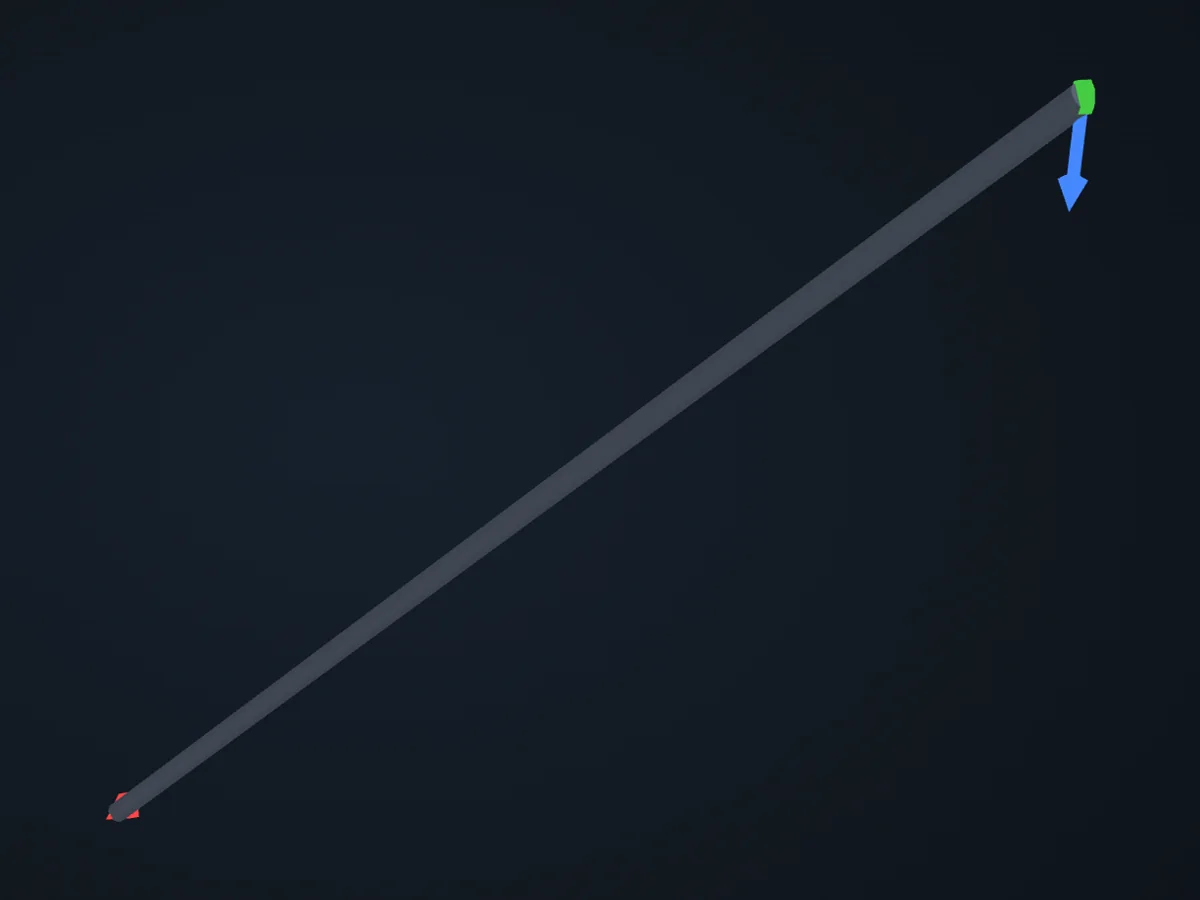
The model before it is solved: its parts, supports (red) and loads (blue).
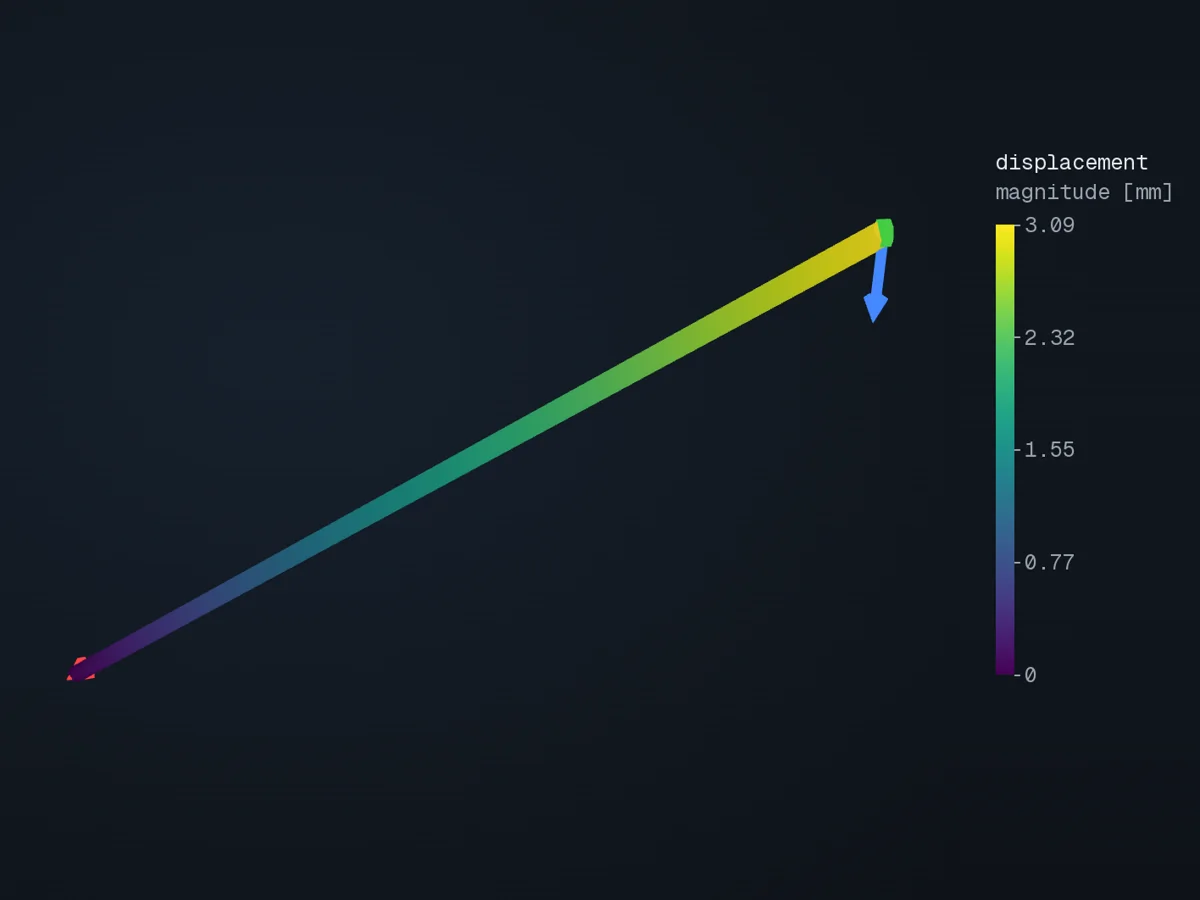
The deformed shape, coloured by displacement (magnitude [mm]), in xfea’s 3D viewer.
Open in 3D turn it, cut it, pick any field: in xfea's viewer, in your browser
The script
Section titled “The script”examples/scripts/02_core_concepts/unilateral_elements/02_compression_prop.py. Run it from the repository with uv run python examples/scripts/02_core_concepts/unilateral_elements/02_compression_prop.py, or, with xfea-examples installed, xfea-examples run 02_core_concepts/unilateral_elements/02_compression_prop.py.
from __future__ import annotations
import math
from xfea.model import (    ElasticIsotropic,    Model,    Node,    Part,    StrutElement,    StrutSection,    TrussElement,    TrussSection,)from xfea.problem import Problem, StaticStepfrom xfea.results import DisplacementFieldResults
from xfea_examples import out_dir

# Geometry / material / loadBASE_X = 0.0            # [mm]TOP_X = 1_500.0         # [mm]  horizontal run of the propTOP_Z = 1_500.0         # [mm]  riseA = 2_500.0             # [mm²] section area (e.g. 50×50 mm timber)F = 20_000.0            # [N]   vertical tip load magnitude
r = math.hypot(TOP_X - BASE_X, TOP_Z)theta = math.atan2(TOP_Z, TOP_X - BASE_X)
timber = ElasticIsotropic(E=11_000.0, v=0.3, density=4.5e-10, name="timber")


def build_prop(name: str, element_cls, section_cls) -> Model:    """Base pinned; top constrained so it can only translate in z."""    model = Model(name=name)    part = model.add_part(Part(name="prop"))    n_base = part.add_node(Node(xyz=[BASE_X, 0.0, 0.0]))    n_top = part.add_node(Node(xyz=[TOP_X, 0.0, TOP_Z]))    section = section_cls(A=A, material=timber)    part.add_element(element_cls(nodes=[n_base, n_top], section=section))
    # Translations-only clamp (pin_bc) on the base — truss and strut elements    # have no rotational DOFs, so constraining rotations with fix_bc would    # produce a solver error on degrees of freedom no element carries.    model.add_pin_bc(nodes=[n_base])    # Top can move only in z (mimics a wall restraint in the horizontal    # plane while letting the load settle vertically).    model.add_rollerZ_bc(nodes=[n_top])    return model

def _axis(n1: Node, n2: Node) -> tuple[float, float, float]:    dx = float(n2.x) - float(n1.x)    dy = float(n2.y) - float(n1.y)    dz = float(n2.z) - float(n1.z)    mag = math.sqrt(dx * dx + dy * dy + dz * dz)    return (dx / mag, dy / mag, dz / mag)

def _elongation(element, disp_field, time) -> float:    n1, n2 = element.nodes    u1 = disp_field.get_result_at(n1, time=time)    u2 = disp_field.get_result_at(n2, time=time)    du = (float(u2.x) - float(u1.x),          float(u2.y) - float(u1.y),          float(u2.z) - float(u1.z))    ax, ay, az = _axis(n1, n2)    return du[0] * ax + du[1] * ay + du[2] * az

def _axial_force(element, disp_field, time, mode: str) -> tuple[float, float, float]:    L_el = float(element.length)    K = float(element.section.material.E) * float(element.section.A) / L_el    delta = _elongation(element, disp_field, time)    if mode == "bilateral":        N = K * delta    elif mode == "tie":        N = K * delta if delta > 0 else 0.0    elif mode == "strut":        N = K * delta if delta < 0 else 0.0    else:        raise ValueError(mode)    return delta, K, N

def solve_case(element_cls, section_cls, tag: str, load_z: float, mode: str) -> dict:    model = build_prop(f"prop_{tag}", element_cls, section_cls)    top_group = model.parts[0].nodes.subgroup(        lambda n: abs(float(n.z) - TOP_Z) < 1e-6    )
    problem = model.add_problem(Problem(name=f"{model.name}_run"))    step = problem.add_step(        StaticStep(            name=tag,            nlgeom=True,            initial_inc_size=0.5,            max_inc_size=1.0,            min_inc_size=1e-3,            max_increments=30,        )    )    step.add_uniform_forcefield(nodes=top_group, z=load_z, load_case=tag)
    disp = DisplacementFieldResults()    step.add_field_outputs([disp])
    try:        problem.analyse_and_extract(path=out_dir(model.name), verbose=False)    except Exception as exc:        return {"ok": False, "error": f"{type(exc).__name__}: {exc}"}
    STEP_END = 1.0    n_top = list(top_group)[0]    element = list(model.parts[0].elements)[0]    try:        dz = float(disp.get_result_at(n_top, time=STEP_END).z)    except (ValueError, TypeError, AttributeError):        dz = float("nan")  # the solver wrote no results: it found no equilibrium    if not math.isfinite(dz):        # The strut went slack and nothing else holds the top: no equilibrium, no force.        return {"ok": True, "no_equilibrium": True, "N": 0.0, "slack": True}    delta, K, N = _axial_force(element, disp, STEP_END, mode)    is_slack = mode in ("tie", "strut") and abs(N) < 1e-3    return {"ok": True, "dz": dz, "delta": delta, "K": K, "N": N,            "slack": is_slack}

def _print_result(label: str, res: dict):    print(f"--- {label} ---")    if not res["ok"]:        print(f"  solver failure: {res['error']}")        return    if res.get("no_equilibrium"):        print("  no equilibrium  : the strut carries nothing in tension and the")        print("                    loaded top is free, so the solver finds no solution")        print("  N               : +0.0 N  (slack)")    else:        tag = "  (slack)" if res.get("slack") else ""        print(f"  top δz   (FEA)  : {res['dz']:+.4f} mm")        print(f"  elongation δ    : {res['delta']:+.4f} mm")        print(f"  N = K·δ (law)   : {res['N']:+.1f} N{tag}")    print()

if __name__ == "__main__":    print("Inclined prop demo — pinned base, roof held against a wall.")    print(f"  geometry : base=(0,0,0) → top=({TOP_X:.0f},0,{TOP_Z:.0f}), "          f"length r={r:.1f} mm, θ={math.degrees(theta):.1f}°")    print(f"  material : E={timber.E:.0f} MPa, A={A:.0f} mm²")    print(f"  load     : F_z at the top (magnitude {F:.0f} N)")    print()
    N_ref = -F / math.sin(theta)    dz_ref = -F * r / (timber.E * A * math.sin(theta) ** 2)    print("Reference (downward load, linear elastic):")    print(f"  N  = -F / sinθ        = {N_ref:+.1f} N")    print(f"  δz = -F·r / (E·A·sin²θ) = {dz_ref:+.4f} mm")    print()
    _print_result(        "TrussElement, load down (compression)",        solve_case(TrussElement, TrussSection, "truss_down", -F, "bilateral"),    )    # The last case solved is one with results: its model is the one left to look at.    _print_result(        "StrutElement, load up   (tension → slack)",        solve_case(StrutElement, StrutSection, "strut_up", +F, "strut"),    )    _print_result(        "StrutElement, load down (compression)",        solve_case(StrutElement, StrutSection, "strut_down", -F, "strut"),    )
print( "Interpretation:\n" " Rows 1 & 3 (downward load): truss and strut both carry the\n" " full compression load and settle by F·r/(E·A·sin²θ). In\n" " pure compression the strut stays on its active branch and\n" " behaves exactly like a regular truss.\n" "\n" " Row 2 (upward load): the strut would need to carry tension\n" " and carries no force in tension — it goes slack, N = 0, and\n" " nothing else holds the top node vertically, so there is no\n" " equilibrium and no displacement to report. That is the\n" " expected physical answer: a prop cannot be pulled.\n" )© 2026 Francesco Ranaudo · Text and pictures CC BY 4.0 · Code Elastic License 2.0 · how to reuse them